

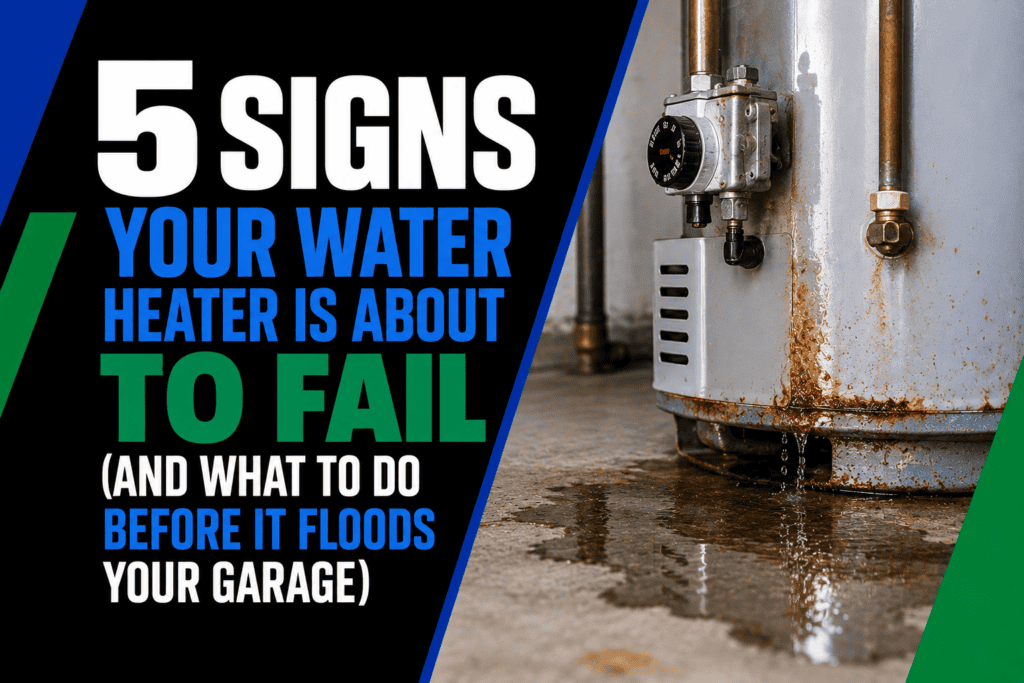
5 Signs Your Water Heater Is About to Fail (And What to Do Before It Floods Your Garage)
Most homeowners don’t think about their water heater until it stops working, and usually that means a cold shower or a puddle spreading across the garage floor. The truth is, water heaters rarely fail without warning. They tell you they’re in trouble weeks or months ahead of time — rumbling, discolored water, a rotten egg smell, a slow drip you keep meaning to check on. If you know what to look for, you can schedule a repair or replacement on your own timeline instead of dealing with a flooded garage and a family with no hot water on a Sunday night.
We’ve pulled a lot of dead water heaters out of Fontana garages, and the pattern is almost always the same: small signs get ignored for months, and then the tank splits open all at once. Below are the five signs we see most often before a full failure, why each one happens, and what you should actually do about it. If any of this sounds familiar, it’s worth getting a professional water heater repair inspection before it turns into an emergency.
1. The Unit Is Past Its Expected Lifespan
A standard tank-style water heater is built to last 8 to 12 years. If you know roughly when yours was installed and it’s already crossed that mark, age alone is a legitimate warning sign — even if it seems to be running fine right now. Most tanks don’t fail gradually and obviously. They fail because internal corrosion has been quietly eating through the steel for years, and by the time you see a leak, the damage has already been done.
Here in Fontana, we tell customers to lean toward the lower end of that lifespan range, not the higher end. Much of the water supply in this area runs 15 to 25 grains per gallon (GPG), which puts us solidly in “very hard water” territory. Hard water carries a heavy mineral load — mostly calcium and magnesium — and every time your water heater cycles, some of those minerals drop out of the water and settle at the bottom of the tank as sediment. Over months and years, that sediment layer thickens into a hard, chalky crust that sits directly on top of the burner or heating element.
That crust does two things, and both of them shorten the life of your unit. First, it acts as an insulating barrier between the heat source and the water, so the heater has to work longer and burn more gas or electricity to get the same amount of hot water — which shows up as a higher utility bill even before anything visibly breaks. Second, and more importantly, it traps heat against the bottom of the steel tank, causing that metal to expand and contract more aggressively than it was designed to. That stress is a major reason water heaters in hard water areas like Fontana tend to fail well before the national average lifespan, sometimes by several years. If your water heater is 7 years old or older, don’t wait for a leak to think about replacement — a technician can check the anode rod and sediment level and tell you honestly how much life is left.
2. Rusty, Discolored, or Metallic-Tasting Hot Water
Turn on a hot water tap and if what comes out looks rusty, brownish, or has visible sediment floating in it, that’s your water heater telling you the tank itself is corroding from the inside. This is different from a one-time discoloration after city water main work — if the cold water runs clear but the hot water is consistently rusty or metallic-tasting, the problem is almost certainly inside the tank, not the municipal supply.
Inside every standard tank water heater is a sacrificial anode rod, usually made of magnesium or aluminum, whose entire job is to corrode instead of the steel tank. It’s a wear item, like brake pads. As long as the anode rod still has material left, it takes the corrosion hit and protects the tank. Once it’s fully consumed — which happens faster in hard water because of the higher mineral content driving more electrochemical activity — the tank’s steel walls become the next thing corrosion attacks. Rusty water is often the first visible sign that this has already started happening.
If you catch this early enough, sometimes replacing the anode rod and flushing the tank buys you meaningful extra life. If the rust has progressed to the point where you’re also seeing rust flakes in the water or the tank itself has visible rust streaks running down the outside, the corrosion has likely already compromised the tank wall, and repair isn’t really on the table anymore — replacement is the only real fix. Either way, this isn’t a “wait and see” situation. Rusty water means active corrosion, and active corrosion only moves in one direction.
3. Popping, Rumbling, or Banging Noises
This is the sign most directly tied to Fontana’s hard water, and it’s also the one most people ignore the longest because the heater technically still makes hot water. As sediment builds up on the bottom of the tank, water gets trapped underneath and inside that layer. When the burner fires and heats the tank, that trapped water boils and turns to steam, and the steam bubbles have to force their way up through the hardened sediment crust to escape. That’s what creates the popping, rumbling, or banging sound — it’s essentially small, contained steam explosions happening inside your tank every time it heats a new batch of water.
A little bit of rumbling on an older unit isn’t necessarily an emergency, but it does mean the sediment layer has gotten thick enough to cause a problem, and it will keep getting worse. Beyond the annoying noise, that sediment buildup reduces your usable hot water capacity (you’re heating a smaller volume of actual water inside the same size tank), increases energy costs, and — as mentioned above — puts ongoing mechanical stress on the tank itself. A professional flush can remove loose sediment and sometimes quiet things down significantly, but if the crust has hardened and calcified over years of neglect, a flush may not fully resolve it, and the tank should be evaluated for how much longer it’s realistically going to hold up.
This is also where a whole-home water softener or conditioning system earns its keep. If you’re tired of fighting sediment buildup every couple of years, looking into water treatment for your home addresses the root cause rather than just the symptom, and it protects every water-using appliance in the house, not just the water heater.
4. Any Moisture, Dampness, or Pooling Water Around the Tank
This is the sign that should move you from “keep an eye on it” to “call someone today.” Water heater tanks are designed to hold pressurized hot water continuously without leaking anywhere except through the designated drain valve and temperature-pressure relief valve. Any moisture around the base of the unit that isn’t coming from one of those two points usually means the tank itself has developed a crack or the seams have started to fail from internal corrosion.
Once a steel tank actually starts leaking from a crack in the tank wall, there is no repair for that. You cannot patch or weld a water heater tank back together in any way that’s safe or code-compliant — the pressure and heat involved make that a non-starter. A leak from the tank body itself means the unit needs to be replaced, full stop.
Where things get less clear-cut is condensation versus an actual leak, and this trips people up constantly. If you have a gas water heater and the weather is humid, or you just filled the tank after draining it, a little condensation on the outside of the tank is normal and not a cause for alarm. The distinguishing factor is whether the moisture keeps reappearing consistently, day after day, regardless of humidity or recent use. Persistent, recurring moisture at the base of the tank — especially if you also notice rust forming on the tank’s outer shell near the bottom — means it’s failing. Don’t wait for it to go from damp to a flooded garage floor. A cracked tank can go from a small puddle to gallons of water on the floor in a matter of hours, and if it happens while you’re at work or asleep, that’s real property damage to drywall, flooring, and anything stored nearby.
5. Inconsistent Water Temperature or Not Enough Hot Water
If your showers have started running lukewarm partway through, or you’re running out of hot water faster than you used to with the same household habits, something inside the unit has changed. A few different things can cause this, and they don’t all mean the same thing for how urgent the fix is.
On gas units, a failing thermocouple or control valve can cause the pilot light to be unreliable, which shows up as inconsistent heating. On electric units, one of the two heating elements can burn out while the other keeps working, which cuts your effective hot water capacity roughly in half without killing the unit entirely — that’s a repair, not a replacement, if caught in time. But if the inconsistency is paired with sediment buildup (see sign #3), reduced tank capacity from that sediment layer is often the real culprit, and it will keep getting worse rather than better on its own.
Either way, don’t just adjust your showering habits around it and call it normal. Inconsistent hot water is a diagnostic clue, and a licensed technician can usually pinpoint the exact component causing it in under an hour. Sometimes it’s a $150 part. Sometimes it’s a sign the tank is on its way out. The only way to know which one you’re dealing with is to have it looked at rather than guessing.
What Actually Happens When a Water Heater Fails Completely
When people picture a water heater “failing,” they usually picture it just stopping — no more hot water, inconvenient but contained. That’s not actually the failure mode we worry about. The expensive, damaging failure is when the tank itself splits or ruptures while still connected to your home’s water supply. A standard residential tank holds 40 to 50 gallons, and it’s plumbed directly to your incoming water line, which means once a tank ruptures, it doesn’t just dump its own contents — it keeps flooding continuously until someone shuts off the water supply to the unit. In a garage, that water often has nowhere to drain and just spreads across the floor and into anything stored nearby, and in some homes water heaters are located in interior closets or upstairs, where a failure can mean water coming through a ceiling below.
This is exactly why the five signs above matter. None of them are subtle if you’re paying attention, and none of them come out of nowhere. A tank doesn’t go from perfectly fine to ruptured overnight — it goes from perfectly fine, to rumbling, to slightly rusty water, to a damp spot at the base, to a flooded garage, over a period of weeks or months. Catching it anywhere in that sequence means a planned repair or replacement instead of an emergency call and a wet-vac at 11pm.
Repair or Replace? How to Actually Decide
Not every warning sign means you need a brand new unit. A stuck relief valve, a failed heating element, a bad thermocouple, or a sediment flush are all legitimate repairs that can add years to a water heater’s working life for a fraction of replacement cost. The decision usually comes down to a combination of three things: the age of the unit, the cost of the repair relative to the cost of a new unit, and whether the tank itself has started to corrode or crack. As a rough guideline, if the unit is under 6 years old and the issue is a component failure rather than the tank itself, repair almost always makes sense. If it’s past 10 years and showing tank-level symptoms like rust or moisture, replacement is usually the more honest recommendation, even if a repair is technically possible in the short term.
If you do end up needing a new unit, it’s worth at least considering a tankless system rather than replacing tank for tank. Tankless units don’t store 40-50 gallons of hot water sitting around collecting sediment 24/7 — they heat water on demand, which sidesteps a lot of the sediment-related failure points that plague standard tanks in a hard water area like ours. They cost more upfront, but for a lot of Fontana households the longer lifespan and lower operating cost make sense. Our team can walk you through whether tankless water heaters are a good fit for your home and household size, or whether a standard tank replacement is the more practical call for your situation and budget.
Whatever you decide, this isn’t a job to hand to just anyone. Water heater work involves gas or high-voltage electrical connections, pressurized water lines, and code requirements around venting and relief valves that vary by city. Hiring a licensed plumber in Fontana who pulls permits and knows the local inspection requirements protects you from bigger problems down the road, including insurance issues if a DIY or unlicensed install ever causes damage.
Don’t Wait for the Puddle
If you’ve noticed any of these five signs — an aging unit, rusty water, popping and rumbling, dampness around the base, or inconsistent hot water — the smart move is to get it checked before it decides the timeline for you. Jason O’Dowd and our team have been diagnosing and replacing water heaters across Fontana, Rancho Cucamonga, Ontario, Chino, Rialto, Colton, Highland, Loma Linda, San Bernardino, and the greater Inland Empire for years, and we know exactly how hard our local water is on these units. We’ll give you a straight answer on whether you need a repair or a replacement, no upselling, and we can usually get a technician out same-day. Contact us or call us directly at (909) 684-1915 before that small drip turns into a flooded garage.