

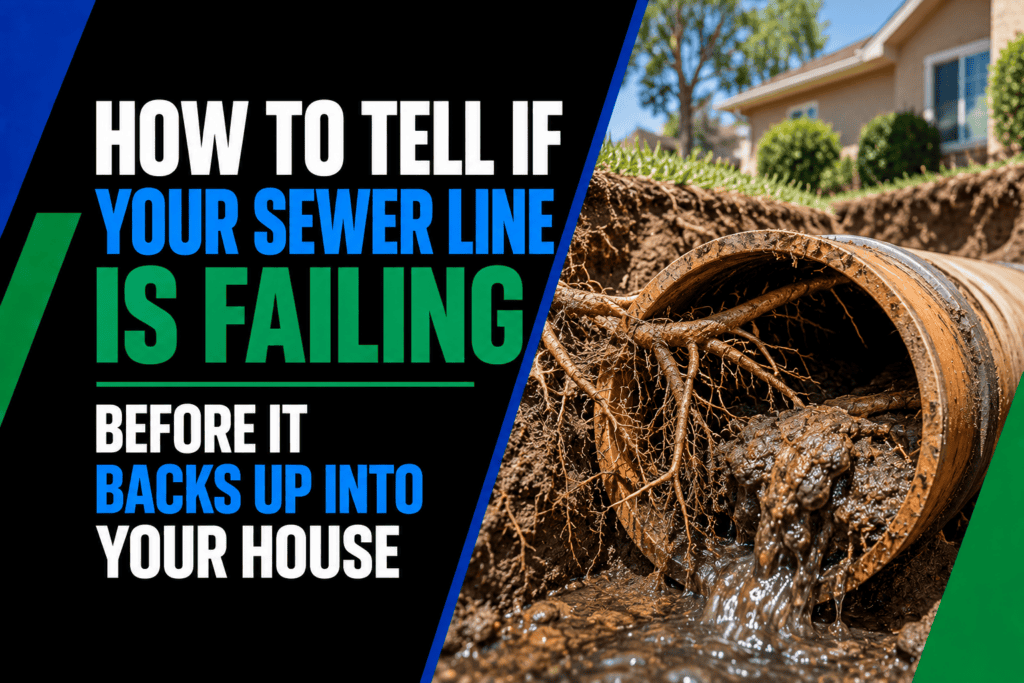
How to Tell If Your Sewer Line Is Failing Before It Backs Up Into Your House
Most homeowners don’t think about their sewer line until it’s too late — until sewage is backing up into a bathtub or coming up through a floor drain in the garage. By that point, you’re not looking at a simple fix. You’re looking at an emergency call, a mess to clean up, and a repair bill that’s a lot bigger than it needed to be. The good news is that a failing sewer line almost never fails without warning. It gives you signs for weeks, sometimes months, before it actually collapses or backs up completely. You just have to know what you’re looking at.
We’ve been doing sewer line repair in Fontana and the surrounding Inland Empire long enough to see the same pattern over and over. A homeowner notices one slow drain and blames it on hair or grease. Then another drain slows down. Then there’s a smell. Then, six weeks later, we’re pulling up a section of yard because a root has completely choked off a 40-year-old clay pipe. Every one of those earlier signs was the sewer line telling them something was wrong. This article walks through exactly what to look for, why it happens underground where you can’t see it, and what to actually do once you spot it.
Slow Drains in More Than One Fixture at the Same Time
A single slow drain — just the bathroom sink, say — is usually a localized clog: hair, soap scum, toothpaste buildup, that kind of thing. It’s annoying, but it’s not a sewer line problem. What should get your attention is when multiple fixtures slow down around the same time, especially fixtures that aren’t connected to each other in any obvious way. If your kitchen sink is draining sluggishly and so is your shower and so is the toilet in the hall bathroom, that’s not three separate clogs. That’s one shared line downstream of all of them running slow, and in most homes, that shared line is the main sewer lateral running from the house out to the city connection.
Here’s why it happens mechanically: every fixture in your house ties into a main drain line before that line exits the house and connects to the sewer lateral in your yard. If something is partially blocking that main line or the lateral itself — a root mass, a bellied section of pipe where waste pools instead of flowing downhill, a collapsed section that’s narrowed the pipe’s diameter — then everything upstream of that blockage backs up a little. Not enough to stop flow completely yet, but enough that water sits and drains slowly instead of clearing fast. If you’re noticing this across multiple fixtures, it’s worth having a professional look at your sewer and drain system before it gets worse, rather than treating each slow drain as its own separate issue.
Gurgling Sounds When You Flush or Run Water
Gurgling is one of the most reliable early warning signs there is, and it’s also one of the most commonly ignored because it seems harmless. Here’s what’s actually happening: your plumbing system relies on air pressure and venting to let water flow smoothly and let waste move out of the house without creating a vacuum or a pressure pocket behind it. When there’s a partial obstruction in the main line or the lateral, air gets trapped between the blockage and the water moving through the pipe. That trapped air has to go somewhere, and it finds the path of least resistance — usually back up through a nearby drain, which is what causes that gurgling or bubbling sound you hear.
If you flush the toilet and hear gurgling coming from the bathtub drain or the sink, that’s air being pushed backward through the system because it can’t escape properly downstream. It’s the same principle as blowing into one end of a partially clogged straw — the air pushes back at you instead of moving through cleanly. A single gurgle now and then isn’t necessarily an emergency, but gurgling that happens consistently, every time you flush or run the washing machine, means there’s a real obstruction forming somewhere in that main line. That’s exactly the kind of thing a camera inspection through drain cleaning service can pinpoint before it turns into a full backup.
Sewage Odor Inside or Outside the House
A properly sealed sewer system should never smell. Every drain in your house has a P-trap — that curved section of pipe that holds a small amount of water at all times specifically to block sewer gas from coming back up into your home. If you’re smelling sewage, one of two things is happening: either a trap has dried out (common in a drain that isn’t used often, like a guest bathroom or a floor drain), or there’s an actual break, crack, or separation somewhere in the sewer line itself that’s letting gas escape before it ever reaches the trap.
Outside the house, sewage odor usually shows up in a specific spot in the yard — often near where the lateral runs, or right around the cleanout. That smell is gas and, eventually, waste escaping through a crack or a joint that’s separated underground. This is common in older homes throughout Fontana that still have their original clay pipe. Clay sewer pipe was standard in residential construction through roughly the 1960s to the 1990s, and it was joined in short sections with mortar or rubber gaskets at each connection. Over decades, those joints are exactly where problems start — they shift, they separate slightly, and they become the entry point for both roots and, eventually, odor and leakage. If you own one of the many homes in Fontana built in that era and you’re noticing a persistent sewage smell anywhere on the property, don’t wait it out. That’s not a smell that fixes itself.
Soggy, Unusually Green, or Sunken Patches in the Yard
This is one of the clearest outdoor signs of a failing sewer line, and it’s often the one that finally gets homeowners to call. If you notice a patch of lawn that’s suddenly greener and more lush than the grass around it, or an area that stays soggy and spongy even when it hasn’t rained and you haven’t been running sprinklers, there’s a good chance wastewater is leaking out of a cracked or separated section of pipe underground and saturating the soil right above it. Sewage is loaded with nutrients, which is exactly why the grass above a leak often grows faster and greener than everywhere else on the property — it’s basically getting fertilized from below.
You might also notice the ground sinking or forming a slight depression along the path of the lateral. That happens when a pipe has partially collapsed and the soil above it settles into the void left behind. In Fontana and across the Inland Empire, this is made worse by our expansive clay soil, which swells when it absorbs moisture in the wetter months and contracts and shrinks during our long dry stretches. That constant expansion and contraction puts real stress on rigid, aging pipe — especially at the joints — and it’s a big part of why sewer laterals in this region tend to develop cracks and separations even in yards where roots aren’t the primary issue. If you see a soggy or sunken patch, that’s worth a camera inspection immediately, before it turns into a full collapse and an unplanned excavation.
Cracks in the Foundation, Slab, or Nearby Concrete
This one surprises people, but it makes sense once you understand what’s happening underground. When a sewer line leaks near or under a slab foundation, it changes the moisture content of the soil supporting that slab. Soil that’s oversaturated in one spot and dry everywhere else doesn’t support the foundation evenly, and that uneven support is exactly what causes cracking, slight shifting, or doors and windows that suddenly don’t close quite right. This is a bigger concern for homes where the sewer line runs close to or under the foundation rather than straight out to the street, but it’s not rare in Fontana’s older neighborhoods where lot layouts and plumbing runs weren’t always planned with modern spacing standards in mind.
You’ll also sometimes see cracking in a driveway, walkway, or patio slab that sits above or near the lateral, for the same reason — the soil underneath is being destabilized by escaping water. If you’re seeing new cracks in concrete anywhere near your sewer line’s path and you’ve also noticed any of the other signs on this list, it’s worth connecting the dots rather than treating the cracking as a separate foundation issue. A licensed plumber in Fontana who does sewer work regularly can tell you fairly quickly whether the plumbing is contributing to what you’re seeing.
An Uptick in Pest Activity — Rodents, Roaches, and Especially Rats
A cracked or broken sewer line is an open invitation for pests, and rats in particular are very good at finding their way into a compromised pipe and using it as a highway into your house. If you’re suddenly dealing with a rodent problem that wasn’t there before, or you’re noticing roach activity concentrated around one bathroom or one section of the house, don’t assume it’s unrelated to your plumbing. Sewer lines are usually sealed systems that pests can’t access. Once there’s a break, a gap at a joint, or a section that’s collapsed enough to create an opening, that seal is gone, and pests will use it.
This is especially common where tree roots have already invaded a line. Mature trees are everywhere in Fontana’s older residential neighborhoods, and their root systems are relentless about seeking out any source of water and nutrients — which is exactly what a sewer line full of wastewater represents to a thirsty root system. Roots find a hairline crack or a slightly separated joint, work their way in, and over months or years grow into a dense mass that both restricts flow and widens the original crack, which then becomes an access point for pests as well. If your home has large trees near the path of your sewer lateral, root intrusion should be high on your list of suspects for any of the signs described above.
Why This Happens So Often in Fontana Specifically
There’s a reason we see this pattern constantly in Fontana and not as much in newer developments elsewhere. A large share of the housing stock here was built between the 1960s and 1990s, and homes from that era were commonly plumbed with clay or cast-iron sewer laterals rather than the PVC used almost universally today. Clay pipe is brittle and joined in short segments, which means more joints per line and more opportunities for root intrusion and separation. Cast iron holds up structurally longer but corrodes from the inside out over decades, eventually thinning to the point of cracking or developing holes.
Layer on top of that the mature trees planted throughout these neighborhoods decades ago, now with root systems fully established and actively seeking water sources, plus the region’s expansive clay soil that swells and shrinks with the seasons and constantly stresses old pipe joints — and you’ve got a near-perfect combination of conditions for sewer line failure. It’s not bad luck when a 50-year-old clay lateral in Fontana starts failing. It’s just the pipe reaching the end of what that combination of materials, tree roots, and soil movement was ever going to allow.
What to Actually Do Once You Notice These Signs
The first step is never guessing. Don’t let anyone talk you into digging up your yard or replacing an entire line based on symptoms alone. The right move is a video camera inspection, where a plumber runs a waterproof camera down the line through an existing cleanout and shows you, in real time, exactly what’s happening inside that pipe — where the crack is, how bad the root intrusion is, whether there’s a bellied section holding standing water, or whether it’s a clean break that’s collapsed the pipe entirely. That footage tells you precisely what repair is actually needed instead of leaving you to guess.
From there, the options depend on what the camera finds. A root intrusion that hasn’t caused structural damage yet can sometimes be cleared mechanically and monitored. A line with multiple failure points or significant material degradation — which is common in older clay and cast-iron laterals — is usually a better candidate for full or partial replacement. And here’s the part that surprises a lot of homeowners: full replacement doesn’t automatically mean tearing up your entire yard, driveway, or landscaping. Trenchless repair methods, including pipe bursting and cured-in-place pipe lining, let us replace or rehabilitate a failing sewer line through small access points rather than digging a trench the full length of the run. It costs less in restoration, takes less time, and leaves your property looking the way it did before we started.
If you’re already dealing with standing water, a backup, or sewage coming up inside the house, that’s not a wait-and-see situation — that’s an emergency plumbing call, and the faster we get a camera down that line, the faster we can stop the damage from spreading into your home.
Don’t Wait for the Backup
Every sign covered here — the slow drains, the gurgling, the smell, the soggy patch in the yard, the cracked concrete, the sudden rat problem — is your sewer line telling you it’s failing before it fails completely. Catching it at the slow-drain-and-gurgling stage means a manageable repair. Catching it after a full backup means cleanup, water damage, and a much bigger bill. If you’re seeing any combination of these signs at your Fontana property, or anywhere else in the Inland Empire, don’t wait for it to get worse. Reach out through our contact page to schedule a camera inspection, or call Jason and the team directly at (909) 684-1915 and we’ll get someone out to take a real look at what’s going on underground.