

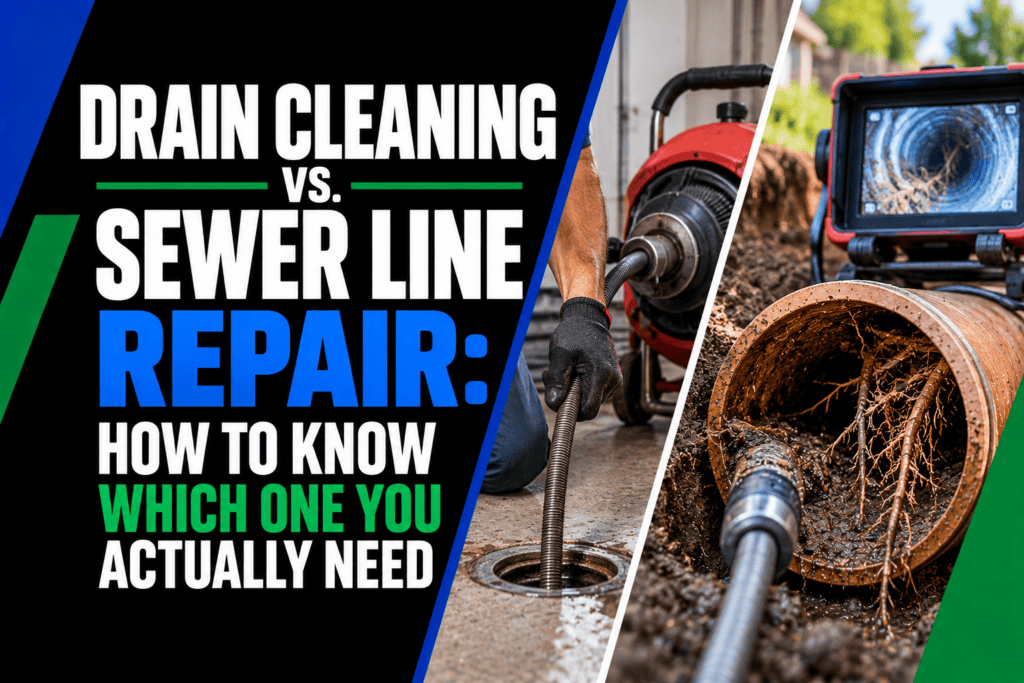
Drain Cleaning vs. Sewer Line Repair: How to Know Which One You Actually Need
A slow drain doesn’t automatically mean you have a sewer line problem, and a sewer line problem doesn’t always announce itself the way people expect. We get calls from Fontana homeowners who’ve already talked themselves into the worst-case scenario over a bathroom sink that just needs a good cleaning. We also get calls where someone’s been plunging the same toilet for three weeks, convinced it’s “just a clog,” when the real issue is sitting under their front yard. Guessing wrong costs you money either way — you either pay for a camera inspection you didn’t need, or you keep pouring drain cleaner down a pipe that’s actually cracked.
The good news is that the difference between a simple clogged drain and a sewer line issue usually shows up in a handful of specific, checkable signs. You don’t need a plumbing license to read them. You just need to know what to look for before you pick up the phone.
The One-Fixture Rule: Is It Just This Drain, or Everything?
This is the single most useful test you can run yourself, and it costs nothing. Go through your house and figure out how many fixtures are actually affected.
If only one sink, tub, or toilet is draining slowly or not at all, that’s almost always a localized clog in that fixture’s own drain line — hair and soap scum in a bathroom sink, food and grease in a kitchen sink, or a buildup of paper and waste in a toilet trap. These are contained problems. The blockage is sitting somewhere between the fixture and the point where its line ties into the rest of your plumbing, and it’s not affecting anything else in the house because it physically can’t — the water backing up has nowhere else to go but back out that one drain.
If two or more fixtures are acting up at the same time, especially fixtures that aren’t near each other — say, your kitchen sink and your upstairs bathroom, or your washing machine and your hallway toilet — that’s a different story. Water and waste from every drain in your house eventually funnel into one main sewer line that runs out to the street. When something is blocking or damaging that main line, every fixture that feeds into it becomes a symptom. You might notice your toilet gurgling when the washing machine drains, or water backing up into your shower when you run the dishwasher. That cross-talk between fixtures that shouldn’t have anything to do with each other is one of the clearest signs you’re dealing with a main line issue rather than a simple clog, and it’s worth having someone look at your sewer and drain systems as a whole rather than chasing one fixture at a time.
Timing Tells You a Lot Too
Pay attention to when the problem shows up, not just where. A single clogged drain is usually consistent — it’s slow or blocked whenever you use that fixture, and it stays that way until something is done about it. It doesn’t come and go based on what else is happening in the house.
A sewer line problem often has a pattern tied to water usage elsewhere. The classic example: you flush the toilet and water bubbles up in the shower drain, or you run a load of laundry and the toilet in the hall bathroom starts to gurgle. That happens because the main line is partially blocked, and pushing a large volume of water into it (like a washing machine cycle) creates backpressure that has to escape somewhere — usually through the lowest or most vulnerable drain in the house, which is often a shower or floor drain. If you’ve noticed your plumbing “talking to itself” like this, that’s not a coincidence and it’s not something a bottle of drain cleaner is going to fix.
Timing can also point you toward outdoor clues. If you’ve got a soggy patch of lawn that stays wet even when it hasn’t rained, a spot near your sewer cleanout that smells like sewage, or a section of yard that’s noticeably greener than the rest (roots love a leaking sewer line), those are signs pointing away from a simple indoor clog and toward something happening underground.
How Often Is This Happening?
Frequency matters as much as severity. A drain that clogs once every year or two, especially if you can point to an obvious cause — a kid flushed something they shouldn’t have, you had a big holiday dinner and the kitchen sink backed up with grease — is normal wear and tear. Regular drain cleaning handles that kind of buildup and you move on with your life.
A drain that keeps clogging in the same spot every few weeks, no matter how carefully you clean it out, is telling you something different. That pattern usually means there’s a partial blockage or a structural problem further down the line — a belly in the pipe where debris settles every time, root intrusion that keeps catching hair and paper as they pass, or a pipe that’s slowly collapsing and narrowing the space water can move through. Snaking the same drain over and over without ever finding out why it keeps happening is a good way to spend money on repeat service calls instead of spending it once on an actual fix. If you’re on your third or fourth call for the same drain in under a year, it’s worth having a camera run through the line instead of scheduling another cleaning.
What Drain Cleaning Actually Involves
Drain cleaning is a targeted, mechanical process aimed at clearing a specific blockage in a specific line. Depending on the clog and its location, that might mean a hand-fed cable snake for something close to the fixture, or a motorized auger for a tougher or deeper blockage. For grease buildup or scale inside older pipes, hydro jetting — high-pressure water that scours the inside of the pipe clean rather than just punching a hole through the clog — often does a more thorough job than snaking alone, and it tends to buy you more time before the same spot clogs again.
A drain cleaning visit is usually a same-day job. There’s no digging, no cutting into walls or slabs, and in most cases no need to shut off water to the rest of the house. You’ve got a clog, we clear it, we test the fixture to confirm water’s moving the way it should, and that’s the job. If we notice something during that process that suggests a bigger issue further down — recurring buildup right at the same point, or a section of pipe that doesn’t clear the way it should — we’ll say so and recommend a camera inspection rather than just charging you to snake the same spot again next month.
What Sewer Line Repair Actually Involves
Sewer line work is a different scope of job because you’re not clearing a clog inside a fixture’s own line — you’re dealing with the main pipe that carries everything out of your house. Before any repair happens, the first step is almost always a camera inspection. We run a scoped camera through the cleanout to actually see what’s going on: root intrusion, a cracked or offset pipe joint, a collapsed section, grease and scale that’s narrowed the pipe over years, or a low spot where solids settle instead of flushing through.
What happens next depends entirely on what that camera finds. Sometimes it’s a localized repair — cutting out and replacing a short damaged section. Sometimes root intrusion can be cleared with a jetting or cutting tool and the line can be relined rather than replaced outright, which avoids digging up your whole yard. In more serious cases, especially with older homes around Fontana and the Inland Empire that still have original clay or cast iron sewer lines, a full line replacement is the more sensible long-term fix rather than patching a pipe that’s going to keep failing in new spots. You can see more detail on how that process works on our sewer line repair page, but the short version is: it starts with seeing the problem, not guessing at it.
Cost and Scope: What You’re Really Comparing
This is where a lot of the anxiety around this question comes from, so let’s be straightforward about it. Drain cleaning is the less expensive, less invasive option in almost every case, and that’s exactly why people hope that’s what they’re dealing with. A standard snake or auger job to clear a clogged fixture drain is a contained service — one technician, one visit, no equipment beyond what fits in the truck, done in an hour or two.
Sewer line repair covers a much wider range depending on what’s actually wrong. A camera inspection and diagnosis is a modest, worthwhile expense on its own, because it tells you exactly what you’re dealing with before you commit to anything bigger. From there, cost scales with scope: clearing roots or scale from an otherwise intact line costs a fraction of what a full excavation and pipe replacement runs. Location matters too — a sewer line under a driveway or mature landscaping costs more to access than one under open lawn.
The reason it’s worth getting this diagnosis right rather than assuming the cheaper option and hoping for the best is that an undiagnosed sewer problem doesn’t stay the same size. A partial blockage from roots gets worse every season as those roots keep growing. A hairline crack lets soil and water in, which erodes the area around the pipe and eventually leads to a collapse. What might be a moderate repair today can turn into a full excavation in a year or two if it’s ignored. Spending a bit on an honest diagnosis now is almost always cheaper than discovering the real problem after it’s forced its way to the surface — literally, in your yard.
Other Warning Signs Worth Knowing
A few more signals are worth keeping in mind, since they don’t fit neatly into the “one fixture vs. multiple” test but still point toward sewer line trouble rather than a routine clog.
- A sewage smell inside the house or in the yard that doesn’t go away, especially near the lowest drain in your home or near the cleanout pipe.
- Water backing up into your bathtub or shower specifically when you flush a toilet, since tubs and showers usually sit at the lowest point in the drain system and take the brunt of backpressure first.
- Gurgling sounds coming from drains that aren’t currently in use, which usually means air is being pushed back through the system from a blockage further down the line.
- Multiple slow drains that all started around the same time, rather than one drain that’s been slow for months.
- Unusually lush or fast-growing grass in one specific area of the yard, which can mean a sewer line is leaking and effectively fertilizing that patch.
Any one of these on its own isn’t necessarily a red flag, but two or three together are a strong reason to have someone look at the main line before it turns into an emergency.
When to Just Call a Plumber and Stop Guessing
If you’ve gone through this and you’re still not sure which side of the line you’re on, that’s normal — some cases genuinely need a camera to settle it, and there’s no shame in not wanting to dig up your yard based on a guess. The honest rule of thumb: if it’s one fixture, it’s recent, and there’s an obvious cause, try a plunger or a basic cleaning first. If it’s multiple fixtures, it keeps coming back, or you’re noticing smells or yard changes outside, skip the DIY step and get it looked at properly.
We serve homeowners throughout Fontana, Rancho Cucamonga, Ontario, Chino, Rialto, Colton, Highland, Loma Linda, and San Bernardino, along with the wider Inland Empire including Riverside, Corona, Pomona, Upland, and Beaumont. If you’re on the Riverside side of things, our Riverside plumbing services cover the same drain cleaning and sewer diagnostic work described here. Jason O’Dowd and our team have run this exact diagnosis hundreds of times, and more often than not, a quick camera look settles the question in a way that guessing never will.
If you’re dealing with a drain that won’t stay clear, multiple fixtures acting up at once, or any of the warning signs above, don’t let it sit while it gets worse. Reach out through our contact page or call us directly at (909) 684-1915 and we’ll help you figure out exactly what you’re dealing with before it costs more than it needs to.