
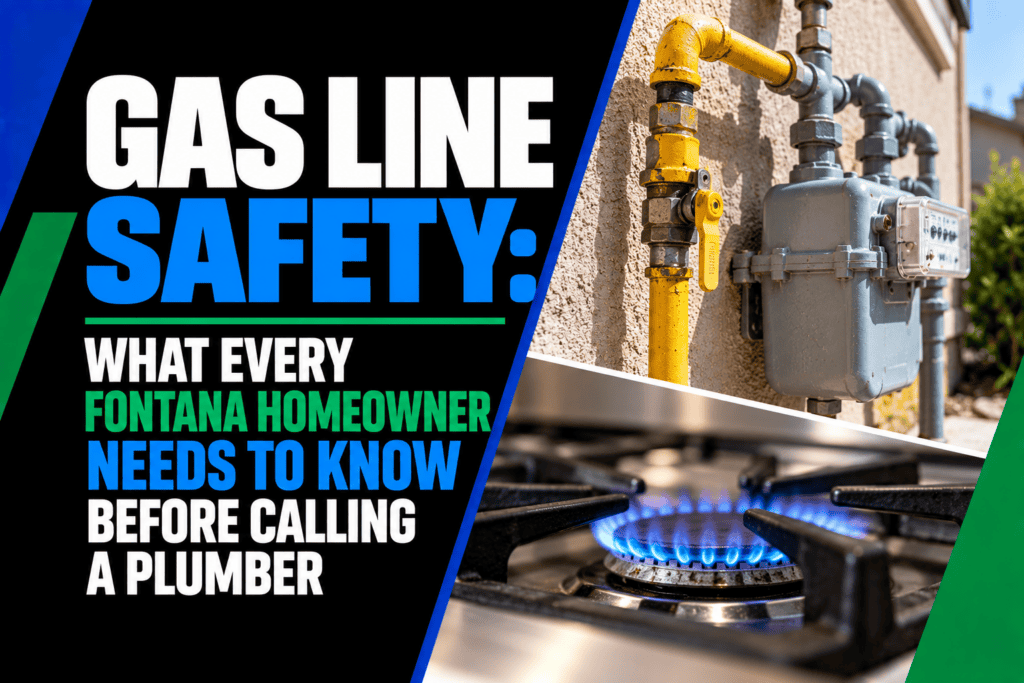
Gas Line Safety: What Every Fontana Homeowner Needs to Know Before Calling a Plumber
A gas line problem isn’t like a dripping faucet or a slow drain. There’s no waiting a few days to see if it gets worse, and there’s no fixing it yourself with a wrench and a YouTube video. Natural gas is what heats most homes in Fontana, runs the water heater, fires up the stove, and keeps the dryer going. It’s also, when a line is damaged or corroded, one of the few plumbing issues that can put a house and the people in it in real danger. Knowing what to watch for and what to do about it is worth five minutes of your time, whether your home was built last year or back in the 1970s.
How to Tell You Have a Gas Leak
Utility companies add a chemical called mercaptan to natural gas specifically so a leak has a smell — on its own, natural gas is odorless. That smell is usually described as rotten eggs or sulfur, and if you notice it anywhere in or around your home, treat it as real until proven otherwise. It doesn’t matter if it’s faint. A weak odor can mean a small leak that’s about to become a bigger one, or it can mean you’re picking up the very edge of a leak that’s stronger somewhere else in the house.
Smell isn’t the only warning sign. A hissing or whistling sound near a gas appliance, meter, or exposed line is another clear indicator, and it’s one people tend to write off as “probably nothing” because it’s quiet and easy to ignore. If you hear it near your water heater, furnace, range, or the gas meter itself, don’t ignore it.
There are a few other, less obvious signs worth knowing:
- Dead, discolored, or unusually dry vegetation in a specific patch of your yard, especially along the path where a gas line likely runs underground — leaking gas displaces oxygen in the soil and kills plant roots.
- A noticeable, unexplained jump in your gas bill, which can point to a slow leak feeding gas into the ground or into a wall cavity rather than through an appliance.
- Bubbles appearing in standing water or wet soil near a buried line, similar to what you’d see with an underground water leak.
- A pilot light that won’t stay lit, or a strange hissing sound coming specifically from an appliance connection rather than the open air.
Any one of these on its own is worth a phone call. More than one at the same time means don’t wait.
What to Do the Moment You Suspect a Leak
The instructions here matter more than most people realize, because a few instinctive reactions are actually the wrong move. If you smell gas or hear hissing, do not flip any light switches, do not unplug anything, do not light a match or a lighter to “check,” and don’t use your phone inside the house. Electrical arcing from a switch or outlet is enough to ignite gas that’s accumulated in a room, and it doesn’t take much of a spark.
Here’s the right sequence:
- Get everyone, including pets, out of the house immediately. Don’t stop to open windows or grab belongings on your way out.
- Once you’re safely outside and away from the structure, call your gas utility’s emergency line. In Fontana and most of the Inland Empire, that’s SoCalGas, and their emergency number is available 24/7. They will dispatch someone to check for leaks and can shut off service to the property if needed.
- If you know where your gas meter is and can reach it safely without going back inside or near the source of the smell, shutting off the main gas valve at the meter can stop the flow while help is on the way. If there’s any doubt about safety, skip this step and let the professionals handle it.
- Once the utility company has confirmed it’s safe and identified the source, call a licensed plumber to actually fix the problem. The gas company will secure the situation, but repairing or replacing the damaged line is plumbing work.
If the situation feels serious — a strong smell, a loud hissing sound, or a leak near an ignition source — call 911 as well as the gas company. It’s better to have more people involved than to underestimate it. For anything that happens outside of business hours, which gas leaks have a habit of doing, A O Dowd Plumbing offers emergency plumbing service so you’re not stuck waiting until morning with an unresolved gas issue.
Why Seismic Gas Shutoff Valves Matter Here
This is a detail that’s specific to living in the Inland Empire, and it’s one a lot of homeowners have never thought about. A seismic gas shutoff valve is a device installed at the gas meter that automatically shuts off gas flow to the house if it detects the kind of shaking associated with an earthquake. The idea is simple: earthquakes damage gas lines and appliance connections, and a ruptured line with gas still flowing is how a single quake turns into a house fire on top of everything else.
Southern California sees regular seismic activity, and Fontana sits close enough to several active fault systems that this isn’t a theoretical concern. Modern building code reflects that reality — new construction and certain renovations require these valves to be installed. The problem is that a large share of homes in this area, including plenty in Fontana, Rancho Cucamonga, Ontario, Rialto, and San Bernardino, were built decades before that code existed. Homes from the 1960s through the 1990s often have their original gas fittings and connections still in place, sometimes with no seismic shutoff valve at all.
Old fittings aren’t automatically dangerous just because they’re old, but they’re more prone to corrosion, wear at connection points, and material fatigue than anything installed in the last few years. Combine that with the absence of a seismic shutoff valve, and you’ve got a house that’s less prepared than it should be for something that isn’t a matter of if, but when. If you don’t know whether your home has one, that’s worth finding out, and it’s a straightforward add-on to a broader inspection of your gas line services needs.
Common Reasons Gas Lines Need Repair or Replacement
Not every gas line issue starts with a leak you can smell from across the room. Plenty of the work we do is preventive or tied to a renovation, and it’s worth understanding the situations that typically call for a plumber rather than a DIY fix or a “wait and see” approach.
Appliance hookups. Installing or replacing a gas range, dryer, water heater, or a system like a tankless unit or a boiler means running or modifying a gas line to match that appliance’s specific requirements. This isn’t a place to cut corners — an improperly sized or improperly connected line can starve an appliance of gas pressure or, worse, create a leak point at the connection fitting. If you’re upgrading a home heating system, for example with a Raypak boiler installation, the gas line work has to be done correctly the first time, because boilers run for hours at a stretch and any weak connection gets tested constantly.
Line relocation. Kitchen remodels, additions, and outdoor living projects like installing a fire pit or an outdoor kitchen often require moving a gas line from where it currently sits to a new location. This is real plumbing work that involves cutting into the existing line, running new pipe, and pressure-testing the whole system before it’s approved for use. It’s not something to attempt without a license, and it’s not something a general contractor should be doing without a plumber involved.
Corrosion and aging pipe. Older galvanized steel gas lines corrode from the inside out, which means a line can look fine on the outside while it’s thinning and weakening internally. This is especially common in homes built before the 1990s that haven’t had their gas lines inspected or updated since the original installation. Corrosion eventually leads to pinhole leaks, and those leaks tend to show up gradually rather than all at once, which is part of why they go unnoticed until someone smells gas or gets a high bill.
Code compliance for older homes. Building codes around gas line materials, sizing, venting, and shutoff requirements have changed significantly over the decades. A line that was fully compliant when a home was built in 1975 may not meet current code, and that matters not just for safety but for anything involving permits, inspections, insurance, or selling the home. Bringing an older system up to code often includes adding a seismic shutoff valve, updating flexible connectors on appliances, and replacing any remaining sections of outdated pipe material.
Underground line damage. Tree roots, ground settling, and even routine yard work like installing a fence post or a sprinkler system can damage a buried gas line without anyone realizing it happened. This is one of the more common causes of the dead-vegetation warning sign mentioned earlier, and it usually requires locating the line, excavating carefully, and replacing the damaged section.
Why This Isn’t a DIY Project
It’s worth being direct about this: gas line work in California requires a licensed plumber, and for good reason. Beyond the obvious risk of fire or explosion, incorrect gas work can lead to carbon monoxide buildup from improperly vented appliances, code violations that complicate a home sale or insurance claim, and failed inspections that hold up a renovation. A licensed plumber pressure-tests every repair or new installation before signing off on it, which isn’t a formality — it’s how you confirm there isn’t a slow leak at a fitting that looked fine by eye.
This holds true across the region, not just in Fontana proper. Whether you’re in Chino, Colton, Highland, Loma Linda, or out toward Beaumont, the building codes and safety standards for gas work are the same, and the risks of getting it wrong don’t change based on zip code.
What a Professional Gas Line Inspection Covers
If you own an older home in the Inland Empire and haven’t had your gas system looked at recently, an inspection is a reasonable thing to schedule even without an active problem. A thorough inspection typically checks the condition and material of existing lines, tests for leaks at every connection point and appliance hookup, verifies that venting and appliance connections meet current code, and confirms whether a seismic shutoff valve is installed and functioning. It’s a relatively quick process, and for a home built decades ago with original fittings, it’s the clearest way to know whether you’re dealing with a ticking clock or a system that’s actually in fine shape.
This matters even more if you’re planning a remodel, buying an older home, or adding a gas appliance. Catching a corroded fitting or a missing shutoff valve during a routine inspection is a lot less stressful than discovering it because you smelled gas at 11 p.m. on a Saturday.
Bottom Line
Gas line issues aren’t common, but when they happen, they don’t give you much room for guesswork. Know the signs — the smell, the hissing, the dead patch of grass, the unexplained bill increase — and know the sequence if you ever suspect a leak: get out, call the gas company, then call a plumber. And if your home was built between the 1960s and 1990s, take the seismic shutoff valve question seriously. It’s a small piece of equipment that does exactly one job, and in earthquake country, it’s a job worth having covered.
If you smell gas, hear hissing near an appliance, or just want an older gas system checked out before it becomes a problem, contact A O Dowd Plumbing or call us directly at (909) 684-1915. We serve Fontana and the surrounding Inland Empire, and gas line safety isn’t something we treat as a lesser priority — it’s the first thing we check.