
Commercial Boiler Repair: What Fontana Business Owners Need to Know Before It Breaks Down
When a residential water heater fails, one family takes cold showers for a day. When a commercial boiler fails, you’re looking at a restaurant that can’t run its dish machine, a hotel with fifty rooms and no hot water, a gym with locker rooms nobody can use, or a medical office that can’t sterilize equipment. The stakes are different at the commercial level, and so is the equipment. If you own or manage a commercial property in Fontana, understanding how your boiler fails, what the warning signs look like, and how to keep a small problem from becoming a five-figure emergency is part of the job now, whether you signed up for it or not.
We’ve been repairing and installing commercial water heating and boiler systems across Fontana and the Inland Empire long enough to know that almost every emergency call we get started as a smaller, ignorable symptom weeks or months earlier. This guide walks through what actually breaks on commercial boilers, how to catch it early, what downtime really costs a business, and how to decide between fixing problems as they happen or paying for a maintenance contract that prevents most of them in the first place.
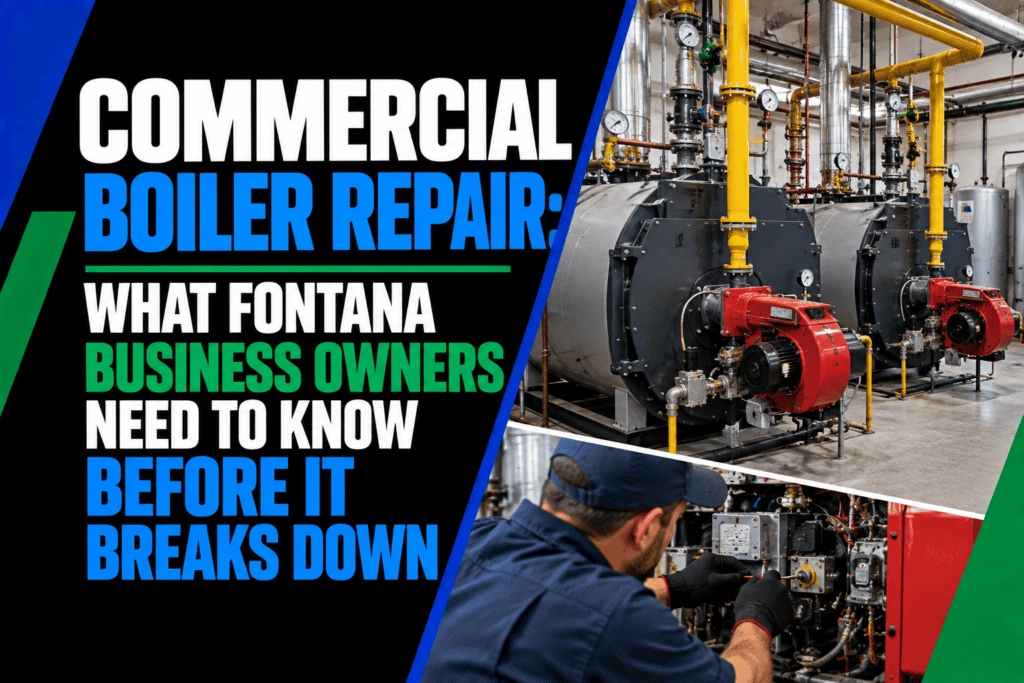
How Commercial Boilers Actually Fail
Commercial boilers take a beating that residential units never see. They’re running longer hours, feeding more fixtures, and often installed in mechanical rooms that don’t get looked at until something’s wrong. A handful of failure points show up again and again on service calls.
Scale and mineral buildup inside the heat exchanger is the most common one we see in this region. The Inland Empire has hard water, and hard water leaves deposits inside boiler tubes and heat exchangers over time. Once scale builds up, the unit has to work harder to transfer heat, which means longer run times, higher gas bills, and eventually a cracked heat exchanger that isn’t cheap to replace. Ignition and burner assembly failures are next — dirty burners, failed igniters, or flame sensors that have drifted out of spec will cause a boiler to lock out entirely, usually at the worst possible time. Circulator pump failure is another big one, especially on older systems where the pump has never been rebuilt or replaced. When the pump goes, hot water stops moving through the building even if the boiler itself is firing fine, which confuses a lot of building staff into thinking the boiler is the problem when it isn’t.
Then there’s control board and sensor failure, which is more common on newer, more electronically sophisticated units. A single failed sensor can shut the whole system down as a safety measure, even though nothing else is actually wrong. And on gas-fired units, venting problems — blocked flues, deteriorated gaskets, or improper draft — can trip safety shutoffs constantly, which looks like a mechanical failure but is really an installation or maintenance issue.
Every one of these failure modes gives off warning signs before the unit actually goes down. The businesses that catch those signs early spend a few hundred dollars on a repair. The ones that don’t spend thousands on an emergency replacement and lose revenue while they wait.
Warning Signs You Shouldn’t Ignore
Short cycling is one of the clearest signals something’s wrong. If your boiler is firing on and off repeatedly instead of running a normal, steady cycle, that’s usually scale buildup, a bad thermostat or aquastat, or airflow restriction. Short cycling puts extra wear on the ignition system and burns more fuel to produce less usable heat, and it tends to get worse fast once it starts.
Uneven heat is another one facilities managers tend to write off as “just how the building is.” If some zones or fixtures get hot water fine while others run lukewarm, that’s often a circulation problem, a failing zone valve, or sediment restricting flow somewhere in the system. It rarely fixes itself, and it usually means something’s actively degrading.
A rising utility bill with no change in usage is a warning sign business owners underrate constantly. Boilers don’t lose efficiency instantly — they degrade gradually as scale builds, combustion drifts out of tune, or insulation breaks down. If your gas or electric bill has crept up over a few months and nothing about your operation has changed, get the equipment looked at before you assume it’s just rate increases.
Error codes are the most direct warning of all, and they’re the one most often ignored because staff either reset the unit and move on, or don’t know who to call. Modern commercial boiler controls log fault codes for a reason — flame failure, high limit trips, low water cutoffs, pressure faults. A code that clears itself and comes back later isn’t a fluke, it’s a pattern, and patterns are exactly what a technician needs to diagnose the real problem before it becomes a full outage.
Strange noises deserve a mention too — kettling or popping sounds usually mean scale has built up enough to create hot spots inside the heat exchanger, which is a precursor to a cracked exchanger and a very expensive repair bill.
What Boiler Downtime Actually Costs Your Business
This is the part that gets underestimated until it happens. A residential customer without hot water is uncomfortable. A commercial property without hot water is often not legally allowed to keep operating, or loses so much revenue that staying open barely matters.
Restaurants need hot water for dish sanitation, and health codes are strict about it. No hot water at the right temperature typically means no service until it’s fixed, which means a full day or more of lost revenue plus the cost of the repair itself, plus whatever it costs to appease customers who showed up to a closed door. Hotels and motels are arguably worse off — fifty or a hundred rooms with no hot water isn’t a minor inconvenience, it’s refunds, one-star reviews, and guests who won’t come back. Gyms and fitness centers depend on locker room showers as part of the membership value proposition; members notice immediately when the showers go cold, and complaints pile up fast on social media and review sites. Medical and dental offices have it worst of all in some ways, because hot water is often tied directly to sterilization procedures required for compliance — a boiler failure there isn’t just an inconvenience, it can mean canceled patient appointments and regulatory exposure.
Add to all of that the emergency repair premium. A boiler that fails on a Friday night and needs a same-day technician costs more than the same repair scheduled during a normal service window, simply because emergency response requires prioritizing your job over others and often means parts get sourced at rush pricing. Add the labor cost of staff standing around unable to do their jobs, the cost of turning away customers, and the reputational cost of a bad week that shows up in reviews for years — and the “just fix it when it breaks” approach starts looking a lot more expensive than it did on paper.
Preventive Maintenance vs. Reactive Repair
Every commercial property owner eventually asks the same question: is a maintenance contract actually worth paying for, or is it cheaper to just call someone when something breaks? Having looked at both sides of this from inside hundreds of mechanical rooms, the math almost always favors maintenance, and here’s why.
A preventive maintenance visit on a commercial boiler typically includes descaling and flushing the heat exchanger, cleaning and adjusting the burner assembly, testing and calibrating safety controls, checking combustion efficiency, inspecting the venting system, and verifying the circulator pump and expansion tank are functioning correctly. Every one of those tasks addresses a failure point discussed above before it turns into an emergency. Regular maintenance also extends the service life of expensive equipment by years in most cases — a well-maintained commercial boiler can run reliably for fifteen to twenty years, while a neglected one may need replacement in half that time.
Reactive repair, by contrast, means you’re always paying emergency rates for problems that had months of warning. You’re also more exposed to catastrophic failures — a cracked heat exchanger or a burned-out control board doesn’t happen instantly, it happens after prolonged neglect of smaller issues, and those bigger failures cost multiples of what routine maintenance would have cost. There’s also the compliance angle: many commercial insurance policies and local code requirements expect documented maintenance on mechanical systems, and a business that can’t produce that documentation after an incident can find itself in a much worse position with an insurer or inspector than the cost of the boiler repair itself.
None of this means every reactive repair is avoidable — equipment fails, parts wear out, and sometimes a system just needs a repair regardless of how well it’s been maintained. But a business running on a maintenance contract turns most of its boiler problems into scheduled, budgeted, inexpensive fixes instead of unscheduled, unbudgeted, expensive ones. If you’re weighing the decision for your property, it’s worth reviewing your options for commercial water heating and boiler service before you’re forced into the decision by a failure at 6 a.m. on a Monday.
Raypak and Commercial Boiler Brands We Work On
Not every plumbing outfit is set up to work on commercial-grade equipment, and it matters which brand and model you’re running. Raypak units are common across commercial properties in this region — restaurants, hotels, multi-family buildings, and commercial laundry facilities all rely on them for high-volume hot water production. Raypak systems have their own quirks when it comes to ignition sequencing, condensate management on high-efficiency models, and control board diagnostics, and a technician who hasn’t specifically trained on the platform can waste hours chasing the wrong problem.
We specifically service and install Raypak commercial boilers in Fontana, along with other major commercial water heating brands, which matters if you’re trying to get a straight answer about whether your unit needs a repair or a replacement. A technician who knows the platform can usually diagnose a Raypak fault code correctly on the first visit instead of guessing, ordering the wrong part, and coming back a second time while your building sits without hot water.
What to Look for in a Commercial Plumber’s Credentials
Commercial boiler work isn’t the same skill set as residential plumbing, and a lot of business owners find that out the hard way after hiring someone who’s great with a leaky faucet but out of their depth on a gas-fired commercial boiler with a building management system tied into it. A few things worth checking before you hand someone the keys to your mechanical room:
- State contractor’s license appropriate for commercial plumbing and gas work, not just a general handyman license.
- Actual experience with commercial-grade equipment — ask directly what brands and tonnage of boilers they’ve worked on, not just “boilers.”
- Proper liability insurance and workers’ compensation coverage, since commercial mechanical rooms carry more risk than a residential bathroom.
- Familiarity with local code requirements and permitting for commercial gas and plumbing work in San Bernardino County.
- A track record of response times that match your operation — a restaurant or medical office can’t wait a week for a callback.
Ask for references from other commercial clients specifically, not residential ones. A plumber who’s done a hundred water heater swaps in houses may have never touched a 500,000 BTU commercial boiler with a building automation interface, and that’s a very different job.
Serving Fontana and the Inland Empire
A O Dowd Plumbing is based in Fontana and run by Jason O’Dowd, and we handle commercial boiler and water heating work throughout Fontana, Rancho Cucamonga, Ontario, Chino, Rialto, Colton, Highland, Loma Linda, and San Bernardino, along with Riverside, Corona, Pomona, Upland, and Beaumont. If you’re a business owner in Chino weighing a repair against a replacement, our page on plumbing services in Chino covers what we handle in that area specifically. For a broader look at everything we cover for commercial and residential clients across the region, our Fontana plumbing services page has the full rundown.
Being local matters more than people think when it’s a commercial boiler on the line. We’re not dispatching a technician from two counties away who doesn’t know the permitting office in San Bernardino County or hasn’t dealt with the water hardness levels specific to this area. We’re already familiar with the buildings, the equipment that’s common here, and what it actually takes to get a business back up and running without a second or third visit.
Don’t Wait for the Full Breakdown
If your boiler is short cycling, running unevenly, throwing error codes, or you’ve just noticed your utility bills creeping up for no obvious reason, that’s the system telling you something before it tells your customers or tenants the hard way. The businesses that come out ahead on this are the ones that call before the failure, not after.
If you’re a Fontana business owner or facilities manager who needs a straight answer on a commercial boiler — whether it needs a repair, a maintenance plan, or a full replacement — get in touch with A O Dowd Plumbing or call us directly at (909) 684-1915. We’ll give you an honest assessment, not a sales pitch, and we’ll get your hot water back online with as little disruption to your business as possible.