

Tankless vs. Traditional Water Heaters: What Actually Makes Sense for a Fontana Home
Every few years a water heater dies and a homeowner in Fontana ends up standing in a cold shower asking the same question: should I just replace it with the same thing, or is now the time to switch to tankless? We get this call constantly, and the honest answer is “it depends” — but not in the vague way that phrase usually gets used. There are specific numbers behind this decision: what you’ll pay to install each type, what you’ll pay every month to run it, how long it’ll actually last in our water, and what kind of household it fits. This isn’t a sales pitch for tankless units, and it isn’t a defense of the old-fashioned tank either. It’s what we tell customers standing in their own garage or utility closet trying to make a call before the warranty on their old unit runs out.
The Real Difference Between the Two, in Plain Terms
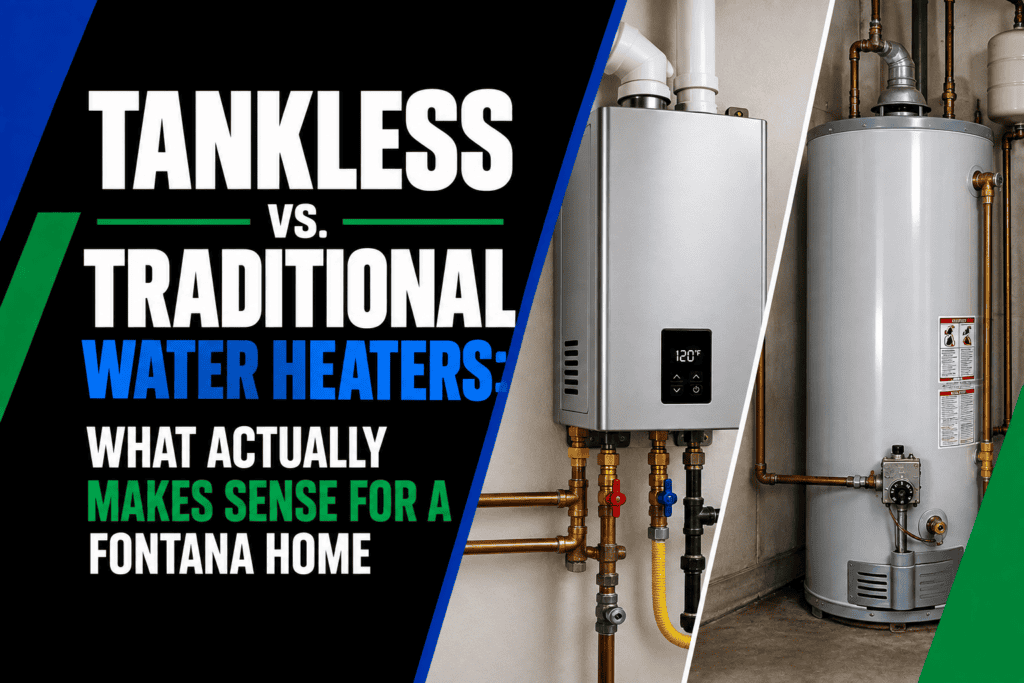
A traditional tank water heater keeps 40, 50, or 75 gallons of water hot around the clock, whether you’re using it or not. The burner or heating element cycles on and off all day to hold that temperature, so you’re paying to keep water hot even while you’re at work or asleep. When you run out of hot water, you’re out — you wait for the tank to recover.
A tankless unit doesn’t store anything. Cold water runs through a heat exchanger and comes out hot on demand, only when a fixture calls for it. There’s no standby tank losing heat, and in theory you never run out — the unit just keeps heating water as long as it’s flowing, up to its rated capacity. That’s the whole pitch behind tankless water heaters: no standby loss, endless hot water, smaller footprint. All true. But “in theory” and “in your specific house” are two different things, and that’s where the real decision lives.
Install Cost — What You’ll Actually Pay in Fontana
This is where a lot of homeowners get surprised, one way or the other. A straightforward like-for-like tank replacement — same size, same fuel type, existing venting and gas line already in place — is the cheapest option on the table. You’re mostly paying for the unit itself, labor, a new expansion tank if code requires it, and haul-away of the old one.
Tankless installs cost more up front, often significantly more, and the gap isn’t really about the unit price — it’s about what has to change around it. Gas tankless units need a larger gas line in a lot of older Fontana homes, because they draw a much higher BTU input for the few seconds they’re actually firing. That means running new gas pipe from the meter or upsizing the existing run, which is real labor and material cost. They also need different venting — most tankless units require dedicated stainless steel or PVC venting depending on the model, not the same flue a tank used. If your home was built before tankless was common, or the water heater sits somewhere that’s hard to vent to the exterior, that install work adds up fast. Electric tankless units avoid the gas and venting issues but often need an electrical panel upgrade to handle the load, which is its own expense.
So the honest range: a straight tank swap is generally the least expensive repair-and-replace job we do. A tankless conversion, when it requires new gas line, new venting, and a condensate drain, can run two to four times that. If you already have a tankless-ready setup — proper gas line sizing and an existing vent path — the gap shrinks considerably. We won’t quote a number here because every house is different, but if a company quotes you tankless “for about the same as a tank” without ever looking at your gas line or vent path, get a second opinion.
Operating Cost — Where Tankless Actually Earns Its Keep
This is the part that takes years to show up on paper, which is exactly why it gets oversold and undersold in equal measure. A tank heater loses heat through its walls constantly — that’s standby loss, and it’s real money leaving your utility bill every single month, twelve months a year, whether you’re running water or not. A tankless unit only burns gas or draws power when hot water is actually being used, so there’s no standby loss to speak of.
For an average household, that difference typically works out to somewhere in the neighborhood of 10-20% lower water heating costs with tankless, though the exact number depends heavily on how much hot water your household actually uses and your local utility rates. A single person or couple who uses hot water in short bursts sees a smaller real-world benefit than a family of five running back-to-back showers, laundry, and a dishwasher every evening — because the tank spends more of its day just idling for that smaller household, which is where tankless saves the most.
Do the math on payback period before you commit. If a tankless install costs several thousand dollars more than a tank swap, and it’s saving you a modest amount per month on your gas bill, that’s a payback timeline that can stretch past the unit’s own lifespan in a light-use household. For a high-use household it pencils out much faster. This is the single most overlooked number in the whole decision, and it’s worth having an actual conversation about your household’s hot water habits before you sign off on either option.
Lifespan — and Why Fontana’s Hard Water Changes the Math
A well-maintained tank water heater typically lasts 8-12 years. A tankless unit, properly maintained, can push 15-20 years — nearly double. That’s a real advantage on paper. But “properly maintained” is doing a lot of work in that sentence, and it matters more here than almost anywhere else in Southern California, because Fontana’s water is hard. We’re typically looking at 15-25 grains per gallon in this area, which is firmly in hard-to-very-hard territory.
Hard water builds mineral scale on any surface it heats, and it builds up faster and does more damage inside a tankless heat exchanger than it does inside a tank. A tank has more surface area and more forgiving tolerances, so scale accumulation is a slower, more gradual efficiency loss. A tankless unit runs water through narrow channels in a compact heat exchanger, and scale buildup there restricts flow, reduces efficiency, and can trigger error codes or shut the unit down entirely well before its rated lifespan if it’s never flushed. Manufacturers of tankless units sold in hard water regions like ours typically call for a descaling flush on a roughly annual basis — running a vinegar or commercial descaling solution through the unit to dissolve mineral buildup before it becomes a restriction.
Skip that flush for a few years in Fontana water and you can turn a 20-year unit into a 10-year unit, along with declining flow and hot water that takes longer to reach temperature. This isn’t a reason to avoid tankless — it’s a reason to budget for the maintenance and actually get it done, or install a water softener ahead of the unit, which extends the life of either type of heater considerably. If you’re already dealing with a tankless unit that’s acting up — long wait times, error codes, or reduced flow — that’s very often scale, and it’s worth having someone look at it before assuming the whole unit is failing; a lot of what looks like a dying heater is actually a $200 flush that got skipped for three years. That’s the kind of call we handle through water heater repair in Fontana more often than people expect.
Maintenance — Two Very Different Commitments
Tank heaters aren’t maintenance-free, but the bar is lower. Draining a few gallons from the bottom of the tank once or twice a year to clear out sediment, checking the anode rod every couple years, and keeping the area around it clear is basically the whole job. Skip all of it and a tank will still probably give you most of its expected lifespan, just with somewhat lower efficiency and a higher chance of the tank itself rusting through eventually.
Tankless maintenance is less optional. Beyond the annual descaling flush already mentioned, the inlet water filter (most units have one) needs periodic cleaning, and the venting and condensate drain on condensing models need to stay clear. None of this is difficult work, and it’s not expensive when it’s done on schedule — but it does need to actually happen. A tankless unit rewards a homeowner who’ll stay on top of a yearly service call and punishes one who won’t. If you’re the type who forgets to change the HVAC filter until it’s visibly gray, be honest with yourself about whether you’ll book an annual flush, or plan to have a plumber put you on a maintenance schedule so it’s not something you have to remember.
Space and Placement
A 50-gallon tank takes up a real footprint — roughly a 2-foot circle of floor space plus clearance, usually in a garage corner or a dedicated closet. A tankless unit mounts on a wall, indoors or outdoors depending on the model, and takes up a fraction of that space. For a garage that’s tight on storage, or a home where the water heater closet is genuinely needed for something else, this is a legitimate, non-trivial reason to go tankless even before you get to the efficiency argument. It’s also relevant for anyone remodeling or converting a garage, where reclaiming that floor space has real value.
Who Actually Makes Sense for Tankless
- Larger households that regularly run multiple hot water fixtures back-to-back and have hit the limits of a tank’s recovery time
- Homeowners planning to stay in the house long enough for the higher install cost to pay itself back through lower operating costs
- Anyone tight on space in the garage or utility area
- Homeowners who are willing to commit to (or pay for) annual descaling given Fontana’s water hardness
- New construction or a full remodel, where gas line and venting can be planned in from the start instead of retrofitted
Who Should Probably Stick With a Tank
- Smaller households with modest, spread-out hot water use where the operating cost savings won’t materialize quickly
- Anyone on a tight replacement budget who needs hot water back today, not after a gas line upgrade
- Homes where venting or gas line upgrades would be unusually expensive due to the water heater’s location
- Homeowners who know they won’t stay on top of annual maintenance and don’t want to install a water softener to compensate
Neither list is a value judgment. We’ve installed plenty of tankless units for families who use every gallon they paid for, and we’ve replaced plenty of tanks with the exact same setup for homeowners who did the math and correctly decided a tank was the better financial call for their situation. The unit that’s “better” is the one that matches your household’s actual hot water use, your budget for both install and upkeep, and how long you plan to stay in the house.
A Note for Commercial and Multi-Unit Properties
Everything above is written for a single-family home. If you’re weighing this decision for a rental property, small commercial building, or multi-unit property in the Inland Empire, the calculation shifts — recovery rate under heavy simultaneous demand, redundancy if a unit goes down, and code requirements all become bigger factors than they are in a house. That’s a different conversation with different equipment options, including commercial-grade tankless banks and traditional commercial boilers, and it’s worth talking through your specific building’s demand before picking either direction. We cover that in more detail under commercial water heating and boilers if that’s closer to your situation.
What We’d Actually Tell You to Do
If your current tank is on its last legs and you need hot water back this week, and the install would require significant gas line or venting work to go tankless, don’t let anyone rush you into a bigger job than you need. A straight tank replacement is a perfectly good, well-proven appliance that will serve most households fine for another decade. If you’ve got time to plan, a household that actually uses a lot of hot water, and you’re willing to commit to yearly maintenance given our water, tankless is a genuinely good long-term investment that will save you money and space over its life.
What actually matters most is getting an honest, house-specific assessment rather than a generic quote — the difference in installed cost between the two options depends entirely on your existing gas line, venting path, and electrical panel, and that’s something that needs to be looked at in person, not estimated over the phone. We handle both types of installs and repairs throughout Fontana and the surrounding area, including Rancho Cucamonga, Ontario, Chino, Rialto, Colton, Highland, Loma Linda, and San Bernardino, and we’ll tell you straight which option makes sense for your specific house instead of steering you toward whichever job pays more.
If you’re trying to decide between tankless and a traditional tank, or your current water heater is already showing its age, give us a call and we’ll walk your setup with you before you spend a dollar. Reach out through our contact page or call Jason and the team directly at (909) 684-1915 and we’ll give you a straight answer, not a sales pitch.