

Water Heater Leaking in Fontana, CA: Where It’s Coming From and What to Do
A puddle around your water heater is one of the more alarming things to discover in your garage or utility closet — and the right response depends almost entirely on where the leak is coming from. Some water heater leaks are minor and fixable quickly. Others mean the unit needs to be replaced before it fails completely and floods the space.
A O Dowd Plumbing responds to water heater leaks throughout Fontana, Rancho Cucamonga, Rialto, Ontario, Colton, and the Inland Empire. Here’s how to identify the source of the leak, what it means, and what to do before we arrive.
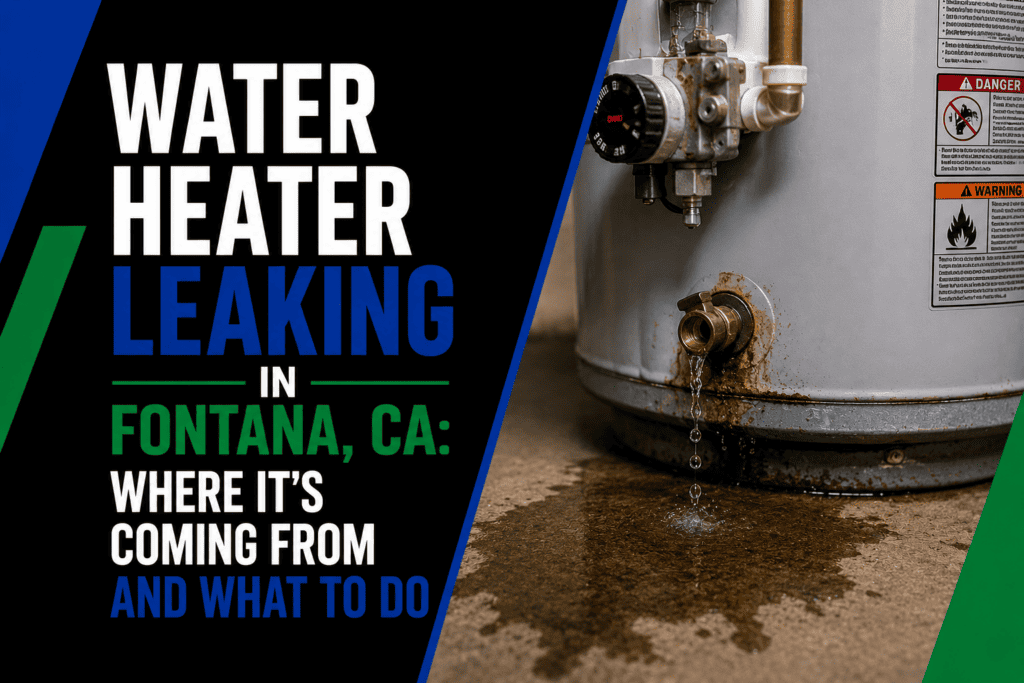
First: Is It Actually the Water Heater?
Before assuming the water heater itself is the source, rule out condensation. In Southern California’s hot summers, cold water flowing into a tank can cause condensation on the exterior — especially with new installations or after cold water from the municipal supply hits the tank on a hot day. Condensation typically appears as scattered droplets or a light film rather than a puddle, and it dries without leaving mineral deposits.
If you’re seeing a genuine puddle, or if water is dripping from a fitting or connection, the water heater needs attention. Here’s where to look.
Common Sources of Water Heater Leaks
The Cold Water Inlet or Hot Water Outlet Connections
The fittings at the top of the water heater — where the cold supply enters and hot water exits — can loosen over time or develop corrosion at the threads. This is one of the more common and straightforward leaks to fix. If the drip is coming from a fitting at the top of the unit and the tank itself is dry, tightening or replacing the fitting is typically all that’s needed. Don’t attempt to over-tighten these yourself — corroded fittings can snap.
The Temperature and Pressure Relief (T&P) Valve
The T&P valve is located on the side of the tank, usually with a discharge pipe running down toward the floor. If this valve is dripping or discharging water, it can mean one of two things: the valve has reached the end of its service life and is failing (in which case replacement is a straightforward fix), or the system pressure or temperature is genuinely exceeding safe limits — which is a more serious issue that needs professional diagnosis immediately. Don’t cap or plug a dripping T&P valve. It’s a safety device; blocking it creates a pressure vessel hazard.
The Drain Valve
The drain valve at the base of the tank is used for annual flushing and is a common leak point, especially on older units where the valve hasn’t been operated in years. A slow drip from the drain valve is often fixed by attaching a hose cap or replacing the valve entirely — an inexpensive repair. If the valve is corroded to the point where it can’t be replaced without risking a larger failure, that factors into the repair-versus-replace decision for the unit overall.
The Tank Body Itself
This is the worst-case scenario — and unfortunately, it happens. Internal corrosion that has progressed through the tank lining will eventually breach the outer shell, causing water to weep through the bottom or sides of the tank. If the leak is coming from the tank body itself, there is no repair. The unit needs to be replaced, and the sooner the better — a tank that’s actively leaking from the body can fail completely with little warning.
If you can see rust-colored water around the base of the unit combined with visible rust on the tank exterior, treat this as urgent. Shut off the cold water supply to the unit and call us.
What to Do When You Find a Leak
- Shut off the cold water supply to the water heater — the valve is on the cold inlet pipe at the top of the unit. Turn it clockwise until it stops.
- Turn the unit to pilot mode (gas) or switch off the breaker (electric) to stop heating water that may be leaking.
- Assess the source using the guidance above — fitting, T&P valve, drain valve, or tank body.
- Call A O Dowd Plumbing — we’ll get a plumber to you quickly and give you an honest assessment of whether repair or replacement is the right call.
Don’t leave a leaking water heater running unattended overnight. Even a slow tank leak can become a significant water damage event if the tank fails while you’re sleeping.
Repair or Replace? The Honest Answer
If the leak is from a fitting, valve, or connection — and the unit is under 10 years old and otherwise in good condition — repair almost always makes sense. If the leak is from the tank body, or if the unit is 10+ years old with multiple issues, replacement is the better investment. We carry tank units for same-day installation and can discuss tankless options if you’ve been considering the upgrade.
Request a free water heater estimate and we’ll assess what you have and give you straight options before any work begins.
Water Heater Leak Repair in Fontana and the Inland Empire
A O Dowd Plumbing responds fast to water heater leaks throughout Fontana, Rancho Cucamonga, Rialto, Ontario, Colton, Chino, and surrounding cities.
Call (909) 684-1915 for fast response. Or request service online — same-day water heater service is often available.