

What Actually Counts as a Plumbing Emergency (And What Can Wait Until Morning)
It’s 11 p.m., you just heard water running somewhere it shouldn’t be, and now you’re standing in the hallway trying to decide if this is a “call someone right now” problem or a “deal with it tomorrow” problem. Every homeowner in Fontana ends up in this exact spot eventually, and the decision you make in the next few minutes can be the difference between a $200 repair and a $5,000 one.
We get calls at every hour of the night, and honestly, about half of them are true emergencies and half of them could have waited until regular business hours. Neither reaction is wrong exactly — nobody wants to gamble with their house, and nobody wants to pay after-hours rates for a toilet that’s just running a little loud. What you actually need is a clear way to tell the two apart, fast, without guessing. That’s what this guide is for.
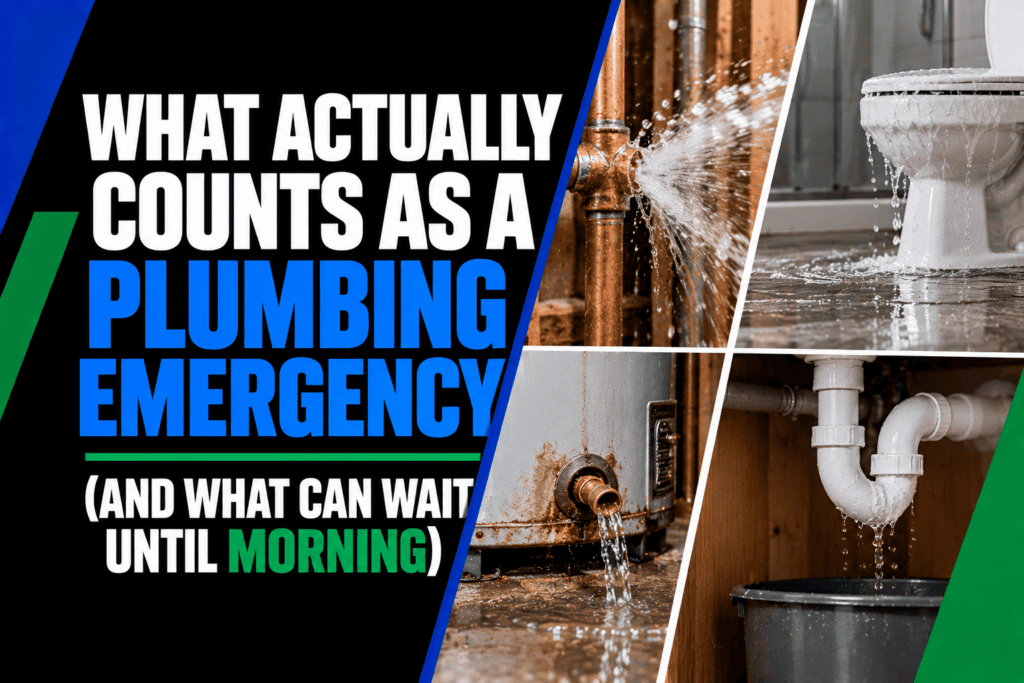
The Plumbing Problems That Are Genuinely Urgent
These are the situations where you stop what you’re doing, act immediately, and call an emergency plumber instead of waiting for morning. If you’re dealing with any of these, don’t talk yourself out of it.
A burst or actively leaking pipe. If you can see water spraying, pooling, or steadily running from a pipe, wall, or ceiling, that’s not a “keep an eye on it” situation. Water damage compounds by the hour — it soaks into drywall, warps flooring, gets into insulation, and creates the kind of mold problem that costs far more to fix than the original leak ever would have. A pipe that’s dripping slowly onto a towel is different from one that’s actively flooding a room, and we’ll get into that distinction below, but a genuine burst pipe with real water flow is always an emergency, day or night.
The smell of gas anywhere in or around your house. This one isn’t really a plumbing call in the traditional sense — it’s a safety call. If you smell rotten eggs or sulfur near your water heater, furnace, stove, or gas meter, get everyone out of the house first, don’t flip any light switches, don’t light anything, and call your gas utility’s emergency line along with a licensed plumber who handles gas line services. Gas leaks don’t get better if you wait. They get worse, and the stakes are your family’s safety, not just your drywall.
Sewage backing up into your home. If wastewater is coming up through a drain, a toilet, or a floor drain instead of going down, you have a main line blockage or a sewer line failure, and this is a health hazard in addition to a plumbing one. Raw sewage carries bacteria you don’t want anywhere near your living space, your kids, or your pets. Shut off the water to the affected fixtures if you can do so safely, keep everyone away from the area, and get someone out immediately.
No water at all, anywhere in the house. A single fixture with no water is usually a localized issue — a stuck valve, a clogged aerator, something minor. But a complete loss of water pressure at every faucet in the house is a different animal. It usually points to a main line break, a serious issue at the meter, or a major failure somewhere upstream of your whole system. If it happens suddenly and every tap in the house confirms it, that’s worth an emergency call, especially if you also notice wet ground near your yard or driveway that wasn’t there before.
A water heater leaking anywhere near electrical components. A water heater that’s dripping from the bottom is a problem, but a water heater that’s leaking near its electrical connections, or one that’s making unusual popping, cracking, or hissing sounds along with visible leaking, is a different level of concern. Water and electricity in the same spot is a shock and fire hazard. Shut off the power to the unit at the breaker if you can safely reach it, shut off the water supply to the tank, and don’t try to troubleshoot it yourself in the dark.
What Can Genuinely Wait Until Regular Hours
Now for the other half — the calls that feel urgent at 11 p.m. but really aren’t. Knowing these saves you money and lets you actually sleep instead of pacing around the house.
A slow, draining sink or tub. Annoying, yes. An emergency, no. A drain that’s slow but still moving water isn’t going to flood your house overnight. Put a stopper in it, avoid running it heavily until morning, and call during business hours. Most slow drains are a straightforward clog that any competent plumber in Fontana can clear in one visit without an after-hours surcharge.
A minor, contained drip. If a faucet or fitting is dripping slowly and you can catch it in a bowl or bucket without it overflowing before morning, that’s a fix-it-tomorrow item. Set a bucket under it, check it before bed, and get it scheduled. A slow drip wastes water and money over time, which is worth addressing, but it’s not going to destroy your home in the next eight hours.
A running toilet. This one drives people crazy because of the noise, but a toilet that keeps running after you flush is almost always a worn flapper or fill valve, not a flood risk. If it’s genuinely non-stop, you can pop the tank lid and gently adjust or jiggle the flush handle to get it to seat, or turn off the shutoff valve behind the toilet if the noise is unbearable. Either way, it can wait for a normal appointment.
Low water pressure at one fixture. If just one showerhead or faucet has weak pressure while everything else in the house is normal, you’re probably looking at a clogged aerator or a partially closed valve, not a system-wide emergency. This is a next-day fix, not a middle-of-the-night one.
A clogged toilet that isn’t overflowing. A clog is frustrating, especially if it’s the only bathroom in the house, but as long as the bowl isn’t actively overflowing onto your floor, you have time. Stop flushing it, use a plunger if you have one, and if that doesn’t clear it, get it on the schedule for the next business day.
The First Five Minutes: What To Actually Do
When you’ve confirmed it’s a real emergency, what you do in the first five minutes matters more than anything a plumber does after they arrive. Here’s the order of operations.
Find your fixture shutoff first, if the leak is localized. Nearly every sink, toilet, and appliance has its own shutoff valve — usually a small oval or round handle on the supply line underneath or behind it. If the problem is coming from one specific fixture, like a toilet supply line or a sink connection, turning that single valve clockwise until it stops can isolate the leak without killing water to the whole house. This is the fastest way to stop damage while you wait for help.
Know where your main water shutoff is before you ever need it. If the leak is a burst pipe inside a wall, a major failure at the water heater, or something you can’t isolate at a single fixture, you need to shut off water to the entire house. In most homes in Fontana and the surrounding Inland Empire, the main shutoff is either near where the water line enters the house — often on an exterior wall close to the street-facing side — or at a valve near the water meter at the curb. Turn it clockwise until it stops. If you’ve never located this valve, do it today, not during an emergency. Standing in the dark trying to find a shutoff valve for the first time while water is pouring into your hallway is a genuinely bad experience, and it costs you nothing to find it now and remember where it is.
Kill the power if water and electricity are anywhere near each other. If water is pooling near outlets, an electrical panel, or an appliance like a water heater, and you can safely reach your breaker panel without stepping through water, shut off power to that area or the whole house. If reaching the panel means walking through standing water, don’t. Call for help and stay clear instead.
Contain what you can, then stop working the problem yourself. Towels, buckets, and moving valuables off the floor are all fine. Trying to cut into a wall to find a pipe, or taking apart a water heater in the dark because you watched a video once, is how a bad night becomes a worse one. Once you’ve shut off water and power where needed, your job is done until the plumber arrives.
Why Calling Immediately Actually Saves You Money
There’s a common instinct to “wait it out” on anything that seems borderline, partly to avoid an after-hours service call. We understand the instinct, but with true emergencies it almost always backfires financially. Water damage doesn’t pause while you sleep. A pipe leaking steadily for eight hours overnight can soak through drywall, subflooring, and baseboards to the point where you’re not just paying a plumber anymore — you’re paying a restoration company, possibly a mold remediation crew, and dealing with an insurance claim on top of it. What would have been a same-night repair turns into weeks of disruption and a bill with several more zeros on it.
The same logic applies to gas smells and sewage backups. A slow gas leak left overnight is a fire and health risk that only gets worse with time and exposure. A sewage backup left sitting is contaminating your home the longer it sits, and depending on your plumbing layout, it can start affecting more than one fixture or room. In every one of these cases, the after-hours rate for a plumber is small compared to what waiting costs you in structural damage, health exposure, or a bigger repair once the problem has had time to spread.
On the flip side, this is exactly why it’s worth being honest with yourself about the things that can wait. Paying an emergency rate for a running toilet or a slow bathroom sink drain doesn’t buy you anything except a higher bill — the problem would have been just as fixable, for less money, during a normal appointment the next day. Being able to tell these apart is what actually protects both your house and your wallet.
Serving Fontana and the Inland Empire
A O Dowd Plumbing has handled emergency calls throughout Fontana, Rancho Cucamonga, Ontario, Chino, Rialto, Colton, Highland, Loma Linda, and San Bernardino, along with Riverside, Corona, Upland, and Beaumont. Homeowners in this area deal with the same aging supply lines, older water heaters, and root-intrusion sewer issues year after year, and the pattern is always the same: the ones who call right away when something’s genuinely wrong come out ahead of the ones who wait. If you’re further out toward Pomona, our Pomona plumbing services cover the same emergency response.
Jason O’Dowd and the team have seen both ends of this — the burst pipe caught in the first ten minutes that turned into a quick repair, and the one that sat overnight and turned into a full remodel. There’s no substitute for knowing, before it happens, what’s actually worth a middle-of-the-night call.
When In Doubt, Call
If you’ve read through this and you’re still not sure which category your situation falls into, that uncertainty is itself a reason to call. A quick phone call costs you nothing but a few minutes, and a plumber who’s answered thousands of these calls can usually tell within thirty seconds of hearing what’s going on whether you need someone out tonight or whether it’s safe to wait. That judgment call is free. Guessing wrong on a real emergency is not.
If water is actively flowing somewhere it shouldn’t, you smell gas, sewage is backing up, or you’ve lost water pressure everywhere in the house, don’t wait until morning to see if it gets better. Contact A O Dowd Plumbing or call us directly at (909) 684-1915 and we’ll walk you through what to do and get someone out to you.