

Why Fontana’s Hard Water Is Quietly Destroying Your Pipes and Appliances
If you live in Fontana, Rancho Cucamonga, Ontario, Chino, Rialto, Colton, Highland, Loma Linda, or anywhere else in this stretch of the Inland Empire, you’re dealing with some of the hardest tap water in Southern California. Most people never think about it until something breaks — a water heater dies at half its expected life, a dishwasher starts leaving a chalky film on every glass, or a shower head slows to a trickle even though nobody touched it. By then the damage has usually been building for years.
This isn’t a scare tactic to sell you a softener. It’s a straightforward look at what’s actually in the water coming out of your tap, what it’s doing inside your plumbing system right now, and what your realistic options are. I’ve been pulling apart water heaters, replacing corroded fixtures, and snaking scaled-up supply lines in this area long enough to know exactly what hard water does to a house over five, ten, and twenty years. Let’s get into it.
What “Very Hard” Water Actually Means
Water hardness is measured in grains per gallon, or GPG. That number tells you how much dissolved calcium and magnesium carbonate is riding along in every gallon that comes through your meter. The general classification scale used by the Water Quality Association looks like this: 0 to 1 GPG is soft, 1 to 3.5 is slightly hard, 3.5 to 7 is moderately hard, 7 to 10.5 is hard, and anything above 10.5 GPG is classified as very hard.
Fontana-area municipal water typically tests between 15 and 25 GPG. That’s not just past the “very hard” threshold — it’s double or triple it in many cases. To put that in perspective, homes in parts of the country with genuinely soft water might see 1 to 3 GPG. Fontana homeowners are dealing with water that’s roughly ten times harder than that, day in and day out, in every load of laundry, every shower, every glass of water, and every cycle your water heater runs.
The source is geology, not anything the water district is doing wrong. Groundwater in this part of the Inland Empire moves through limestone and dolomite deposits before it ever reaches a treatment plant, and it picks up calcium and magnesium ions along the way. Municipal treatment removes pathogens and balances chemistry for safety, but it doesn’t strip out hardness minerals — that’s not what a treatment plant is built to do, and honestly it’s not required to. The result is water that’s perfectly safe to drink and completely brutal on plumbing infrastructure over time.
What’s Actually in the Water
The two minerals doing all the damage are calcium carbonate and magnesium carbonate. On their own, dissolved in water, they’re invisible and mostly harmless to drink. The problem starts the moment that water heats up, evaporates, or sits still for any length of time. When water is heated, its capacity to hold dissolved minerals in solution drops, so calcium and magnesium start falling out and bonding to whatever surface they’re touching — pipe walls, heating elements, fixture threads, glass, tile, anything. That’s scale. It’s the same chemistry as stalactites forming in a cave, just happening inside your plumbing instead of underground.
Every time hot water runs through your system, a microscopically thin layer of mineral deposit gets left behind. It doesn’t matter how “clean” your water looks coming out of the tap — hardness minerals are dissolved, not suspended, so you won’t see them until they’ve already crystallized somewhere in your system.
Scale Buildup Inside Your Pipes
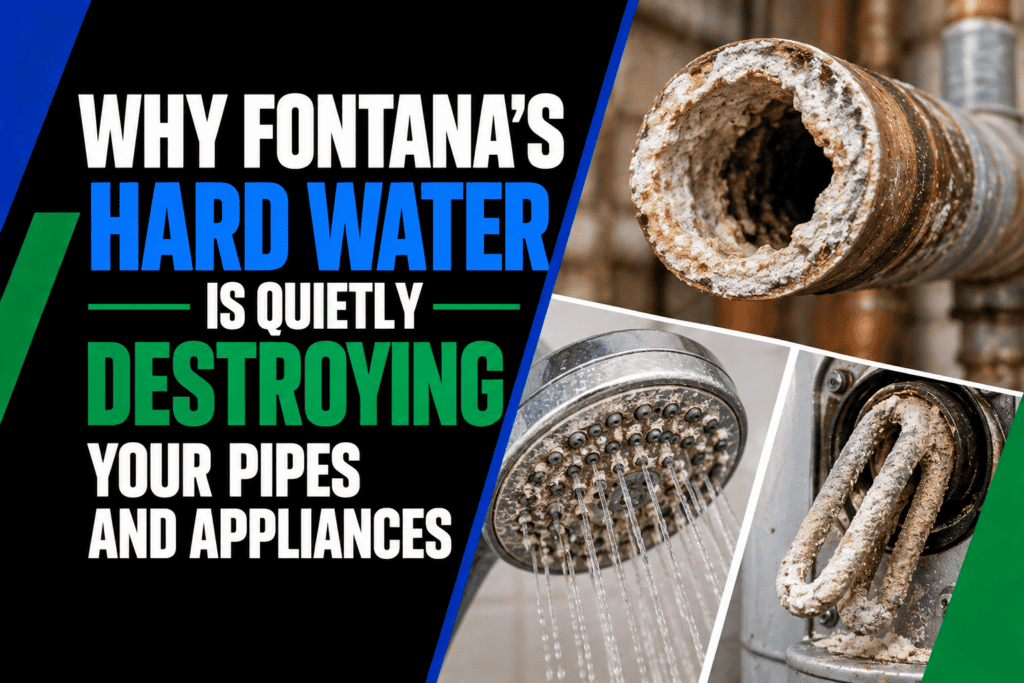
Inside copper and galvanized supply lines, scale accumulates on the interior walls in layers, the same way plaque builds up in an artery. Over years, that buildup narrows the effective diameter of the pipe. A 3/4-inch line that’s been carrying 20 GPG water for fifteen years can have a genuinely reduced interior diameter, which means lower flow rate and lower water pressure at every fixture downstream — even though nothing about the pipe itself has “failed.”
In galvanized steel pipe specifically, hard water accelerates the process that eventually clogs the line solid, because the mineral scale bonds aggressively to the zinc coating and gives corrosion something to grab onto. We pull sections of galvanized pipe out of Fontana-area homes on a regular basis that are two-thirds blocked with a rock-hard mineral crust. The homeowner usually just thought their water pressure had “always been kind of low.”
PEX and copper hold up better than galvanized, but they’re not immune. Scale still deposits at fittings, valves, and anywhere the flow slows down or changes direction — angle stops under sinks, shutoff valves, the inlet screens on faucets. If you’ve ever had a plumber tell you a valve is “seized” and needs to be cut out rather than turned, hard water scale is very often the reason.
Your Water Heater Is Taking the Worst of It
Nothing in your house absorbs more hard water damage than your water heater, because it’s the one appliance whose entire job is to heat water — which is exactly the process that triggers mineral precipitation. In a tank-style water heater, calcium and magnesium settle out and accumulate as sediment at the bottom of the tank, right on top of the heating element or directly above the gas burner.
That sediment layer acts as insulation between the heat source and the water, which means the unit has to work harder and run longer to reach the same temperature. Studies from the Water Quality Research Foundation and the Battelle Memorial Institute have found that as little as a half-inch of scale buildup can reduce heating efficiency by 10 to 12 percent, and heavier buildup pushes that number considerably higher. You’re paying more on your gas or electric bill for the exact same hot water output.
It gets worse over time. On gas water heaters, sediment sitting against the tank bottom causes localized overheating and stress on the tank lining, which is a major contributor to premature tank failure — cracked glass linings, popping or rumbling noises during heating cycles (that’s literally water boiling underneath a crust of scale), and eventually a leak at the tank seam. On electric units, scale buildup around the heating element causes it to overheat and burn out well ahead of schedule. A water heater rated for a 10 to 12 year service life commonly fails in 6 to 8 years in untreated Fontana-area water, sometimes sooner.
If your water heater is making popping or crackling sounds, taking noticeably longer to deliver hot water, or your energy bills have crept up without an obvious cause, hard water scale is the first thing worth ruling out. It’s also the reason so many water heater repair calls in this area turn into “the tank needs to be flushed and the anode rod is shot” rather than a simple fix. If you want a professional look at what’s actually happening inside your unit, our water heater repair team in Fontana deals with scale-related failures on a near-daily basis and can tell you honestly whether flushing and maintenance will extend its life or whether you’re better off replacing it before it fails on its own schedule.
Fixtures, Aerators, and Showerheads
The smallest openings in your plumbing system are the first to show visible symptoms, because it doesn’t take much scale to choke off a narrow passage. Faucet aerators — the little mesh screens at the tip of a faucet — are a textbook example. Hard water minerals build up on the screen mesh and inside the aerator body, restricting flow until you’re left with a faucet that sprays sideways or barely dribbles.
Showerheads are even more obvious. Look at the spray holes on any showerhead that’s been in a Fontana-area home for a year or two without maintenance and you’ll usually see white or greenish-white crust ringing each opening, sometimes closing several holes completely. That’s calcium carbonate crystallizing at the point where hot water exits and cools rapidly — the exact conditions that cause scale to precipitate fastest. A showerhead that used to deliver solid, even pressure gradually turns into an uneven, weak spray, and most people assume it’s a plumbing pressure problem rather than a $12 part clogged with mineral deposits.
Toilet fill valves, washing machine hoses, and even the small solenoid valves inside dishwashers and ice makers suffer the same fate. These are precision components with narrow tolerances, and hard water scale is exactly the kind of gradual, invisible buildup that causes them to stick, leak, or fail years before they should.
Spotting on Dishes, Glassware, and Fixtures
This is the symptom most homeowners notice first, even if they don’t connect it to hardness. Hard water spots on dishes and glassware aren’t food residue or a dishwasher malfunction — they’re mineral deposits left behind as water droplets evaporate and leave calcium and magnesium behind on the surface. Glassware in particular shows this clearly because it’s transparent: you get a cloudy, etched-looking film that regular dish soap won’t touch, and over time that film can actually etch into the glass surface permanently if it’s not addressed.
The same thing happens on chrome fixtures, glass shower doors, and stainless steel sinks. White, chalky spots and streaks on a shower door are calcium carbonate crystallizing out of water that dried on the surface rather than getting wiped away. It’s cosmetic, but it’s also a visible sign of exactly what’s happening inside pipes and appliances where you can’t see it.
Dry Skin, Dry Hair, and Soap That Won’t Cooperate
Hard water changes how soap and shampoo behave chemically. Calcium and magnesium ions react with the fatty acids in soap to form an insoluble compound — this is literally soap scum, the same ring you scrub off a bathtub. Instead of soap rinsing cleanly off your skin and hair, a portion of it binds with the minerals in the water and leaves a residue behind rather than washing away.
That residue is a big part of why people in hard water areas report dry, tight-feeling skin and dull, harder-to-manage hair even when they’re using the same products that worked fine somewhere else. It’s also why you typically need more soap, shampoo, and laundry detergent to get an equivalent clean in hard water — the minerals are neutralizing part of every dose before it can actually do its job. Laundry washed repeatedly in hard water tends to look dingier and wear out faster too, because mineral deposits get trapped in the fabric fibers themselves.
Appliances Wear Out Faster Across the Board
Water heaters get the worst of it, but they’re not alone. Dishwashers, washing machines, coffee makers, ice makers, and refrigerator water lines all move heated or repeatedly-cycled water through narrow internal components, and all of them accumulate scale in the same way. Heating elements in dishwashers and washing machines scale up just like water heater elements do, reducing efficiency and shortening service life. Internal valves and pumps wear out faster because scale acts as an abrasive against seals and moving parts.
Manufacturers are aware of this — plenty of appliance warranties include specific language about hard water damage and mineral buildup, sometimes explicitly excluding it from coverage. If you’re replacing dishwashers, washing machines, or water heaters more often than friends or family in lower-hardness areas, this is very likely why.
What Actually Fixes This
There are two real solution paths here, and they solve different problems, so it’s worth knowing the difference before you spend money on either one.
A water softener addresses hardness directly. It uses an ion exchange process — resin beads swap sodium or potassium ions for the calcium and magnesium in your water — so the water leaving the softener is genuinely soft, typically under 1 GPG. This is the only approach that actually stops scale formation at the source, protecting your water heater, pipes, fixtures, and appliances at the same time. Salt-free “water conditioners” are also on the market; they don’t remove hardness minerals the way a softener does, but they alter the mineral structure so it’s less likely to adhere to surfaces as hard scale. They’re a reasonable option for households that want to avoid sodium in their water or skip the maintenance of a salt-based system, though a true softener generally delivers more complete, more measurable results for a house dealing with 15 to 25 GPG water.
Filtration is a separate issue and solves a different problem — it targets chlorine, sediment, and taste/odor issues rather than hardness itself. A lot of homeowners install a filtration system expecting it to fix hard water and it doesn’t, because that’s not what it’s designed to do. The two systems work well together: filtration for water quality and taste, softening for hardness. If you’re looking at your options, our team walks Fontana-area homeowners through water treatment systems sized correctly for a house running 15 to 25 GPG water, and separately handles water filtration installations for households that want cleaner-tasting, lower-chlorine water on top of solving the hardness problem.
Whichever direction you go, sizing matters. A softener rated for a smaller household or lower hardness level than what you’re actually dealing with will underperform and need constant salt refills, while an oversized system is just wasted money. This is a case where getting a real water test and a professional recommendation, rather than guessing based on a big-box store display model, saves you from buying the wrong equipment twice.
What This Means Across the Inland Empire
The 15 to 25 GPG range isn’t unique to Fontana proper — it’s consistent with source water shared across much of this region, including Rancho Cucamonga, Ontario, Chino, Rialto, Colton, Highland, Loma Linda, and San Bernardino, along with nearby communities like Riverside, Corona, Pomona, Upland, and Beaumont. If you’re in one of those areas and you’ve noticed the same symptoms — an aging water heater that sounds like it’s boiling gravel, showerheads that clog every few months, glassware that never quite comes out clear — you’re not dealing with a local fluke. It’s the same regional water chemistry causing the same damage in nearly every home nearby. We handle water treatment and plumbing service throughout that footprint, including for homeowners working with our plumber in Corona on hard water and fixture issues tied to the same source water.
Where to Go From Here
None of this fixes itself, and it doesn’t get better with time — scale buildup is cumulative, not seasonal. The good news is that once you know what’s actually causing the spotting, the short water heater life, the weak shower pressure, and the dry skin, the fix is straightforward: get the water tested, get the right equipment sized for your household, and get it installed correctly the first time.
If you want a straight answer about what’s going on with your water heater, your pressure, or your fixtures — no upsell, just what we’re actually seeing when we open things up — give us a call. Jason O’Dowd and our crew have been diagnosing and fixing hard water damage in Fontana and across the Inland Empire for years, and we can tell you plainly whether you’re looking at a softener, a repair, or both. Reach out through our contact page or call us directly at (909) 684-1915 to get a real assessment of what your water is doing to your home.